Featured Post

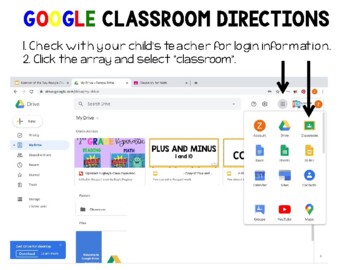
Avoid Quarter 2 Blues: Save Time with a new Google Classroom

For those of you ending the quarter, now is the time to create a new Google Classroom for each of your classes. Organizing new classes will...

Friday, April 28, 2023

Do you like free stuff? Scholarships and Edtech Updates.

Free Stuff!

First, because the deadline is April 30, have you thought about professional learning this summer? The Modern Classrooms Project has a limited number of scholarships (a $750 value!) available for their Virtual Summer Institute, which provides self-paced learning and networking opportunities for five weeks, along with individualized coaching from Expert Mentors who use the model. If you want to learn more about using blended learning to increase student mastery and make teaching more enjoyable and sustainable, check out this AMAZING opportunity! 
Special scholarships are also available for special educators!

EdTech Updates

Canva now has Magic Write and Magic Design. 
These AI tools are a great way for teachers to start documents and presentations fast...but it is also a tool students might be using, so teachers need to be aware. Here's a walk-through of how Magic Write works:


If you haven't tried Canva, educators and students can use it for free! It has expanded to include so many capabilities for document design, visuals, and video editing that it is worth checking out. Let members of TLI know if you would be interested in professional learning on this.


Flip now has a Reading Coach in Immersive Reader!
Looking for kids to get feedback on their oral reading? Then this might a tool for you. Check out how it works in this video:

And, even if you just want to have a tool to read text aloud to students or support student reading, consider using Flip and the Immersive Reader to support student learning.

Do you use Newsela? The paywall is rising...

Beginning this summer, users with free Newsela accounts will only have access to a handful of current event articles each month, selected by the Newsela team. One article will be released a week, and articles will disappear after four weeks. The company shares that "Our full catalog of 8,000+ leveled news and current events articles will only be available in our premium products."

Friday, April 21, 2023

Differentiation with Station Rotation

In the past few weeks, we've seen some awesome station rotation lessons at GMS and GHS.

In one GMS special educator's classroom, students were able to experience a variety of tasks and work in a variety of ways on math problems. At one station, students played a competitive game with dice and a game board. At another station, students completed individualized practice on the computer. And at another station, students worked collaboratively. The teacher was able to casually circulate, providing support and feedback to individuals, as needed.

One GHS social studies teacher used the station rotation to break apart and scaffold a complex document-based response activity. Instead of giving students a huge packet of resources, students rotated to different pieces of evidence around the room and used guiding questions to support their comprehension and analysis of these documents. The teacher was able to target support to each group based on their document, and an early finisher station allowed some students to move ahead at their own pace. By tackling the task piece by piece and in collaboration with peers, the students were more engaged with the topic and more eager to write a response.

A GHS special educator used station rotation to have the opportunity to pull students in small groups for targeted instruction according to a timed rotation, with other students working on independent tasks at other stations. The rotations allowed her to provide differentiated content and processes for students based on their needs and abilities. The teacher was able to provide real-time, high-quality feedback to students as they worked, allowing them to be partners in the learning process and ensure that their practice was perfect.

Perhaps most interestingly, the teachers shared that not only were they more relaxed in the pace of the station rotation, but the students happier and more on task. Several of them used technology, like video or slides tutorials, to free themselves from needing to explain things to the class, and others used ready-made online practice to support personalization of practice.

These teachers showcased how station rotation can be used for a myriad of tasks and in support of differentiation. There are so many ways to use station rotation to make life better for teachers and students. If you want more ideas or answers to frequently asked questions, check out this blog post from Catlin Tucker or talk to a member of TLI.


Thursday, March 30, 2023

Just Escape


Escape rooms aren't new, but they are a game-based learning technique worth dusting off when review threatens to get stale. Kids as young as preschool can find success with these tasks when provided the right modeling and support!

The Benefits

We recently observed a 4th grade teacher using an escape room in math to review place value/rounding. In addition to the benefit of the task being fun and academically engaging, the teacher and students experienced additional academic and SEL benefits. According to the teacher:  

One of the greatest parts about using the [digital] escape rooms is the computer knows the correct answer so the students are provided with direct feedback as to whether their response is correct or incorrect. This allows for me to be able to assist students without having to provide each student in the class with feedback (checking their work immediately).

Students love the challenge of attempting to "escape" and they dive right into each escape room, determined and ready to solve any problem. I typically have them work in partnerships/small groups in order to be able to discuss and share their thinking. Many times, there is quite a bit of dissonance taking place and I absolutely love it. I am consistently telling them to persevere and they own it!

This aligns with the research: in addition to supporting motivation, game-based learning contributes to stronger problem-solving skills, language development, memory, self-esteem, and cooperative work skills.

Planning an Escape

https://ditchthattextbook.com/30-digital-escape-rooms-plus-tips-and-tools-for-creating-your-own/

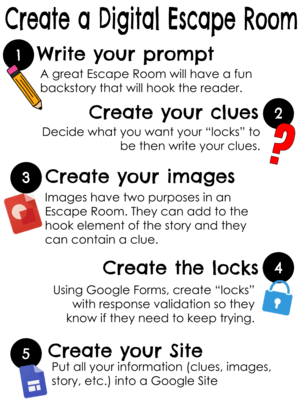
There are many pre-made escapes and templates you can use to build your own escape room, such as those that use Genially or Google forms or Google sites.

But really, before doing any of that (admittedly fun) stuff, be sure you have a clear picture of the skills you want your escape room to test: what is the focus? How will the applications show student mastery of the concepts and skills you have been covering in class?

If an escape room sounds like something you want to do, someone from TLI would love to support you in the planning process, whether it is helping with the template, the plan, or even just connecting you with another teacher who has used an escape room in your content area or grade level.

Game on!

Thursday, March 23, 2023

Managing March Behaviors with "Better" Questions

We've heard from teachers that students are antsy and testing limits, so it must be March, the longest teaching month.

A recent podcast and article by Dr. Angela Watson shared some wisdom that just might help with this. She asks us to consider how asking better questions of our students can garner better results.

In "The Power of Asking Better Questions," she shares that just by asking students who are off-task, "What should you be doing right now?" she enters into a productive discussion with students instead of a power struggle. Instead of asking, "What are you doing?" which is self-evident and likely annoying in some way, the teacher can ask a question that they might actually want the answer to. 

Seriously, how often has a student, when asked "Why are you pushing him?" delivered a satisfactory answer?

By training yourself to calmly prompt the student with a version of "What should you be doing right now?", you encourage the student to draw upon their executive skills: they have a moment to consider their choices, and often, a reminder to make a better one without shame or embarrassment. If the student replies with an answer that shows they know the directions, you could follow up with, "How can I help you get started?" or "Is there anything you are stuck on?" If, on the other hand, the student says, "I don't know," or names something outside the scope of your directions, then this provides you the opportunity to clarify or:

"bridge the gap between what [you] need the student to do and what the student feels they need to do. It gives some insight into what's distracting the student or causing them to make choices that aren't aligned with [your] expectations."

The examples of questions and their alternatives are all too relatable:

  • "Why is your coat on the floor?" becomes, "Where should your coat be?"
  • "Why aren't you on the right page of the textbook?" becomes "What page should you be on?"
  • "Why is your cell phone out?" becomes "Where should your cell phone be right now?" 

Your sincerity and your acknowledgment of their control over the situation will yield a much more satisfactory response than the alternative. Really, you are shifting your mindset and giving students agency by reframing the question. 

So when you are feeling frustrated with student behavior, take a deep, calming breath, and sincerely ask the student a question that provides an opportunity to think about their choices and the expectations. 

What should you be doing right now?

It might take practice, or it might take a sticky note on your ID, but if you get in the habit of asking the better question, you will find you'll get a better response.


Saturday, March 11, 2023

Infinite Campus: Use the Knowledge Base & Save time with Student Groups

 If you haven't gone into Infinite Campus's Community, you should check out the Knowledge Base. This menu provides tutorials for features that will streamline your work.

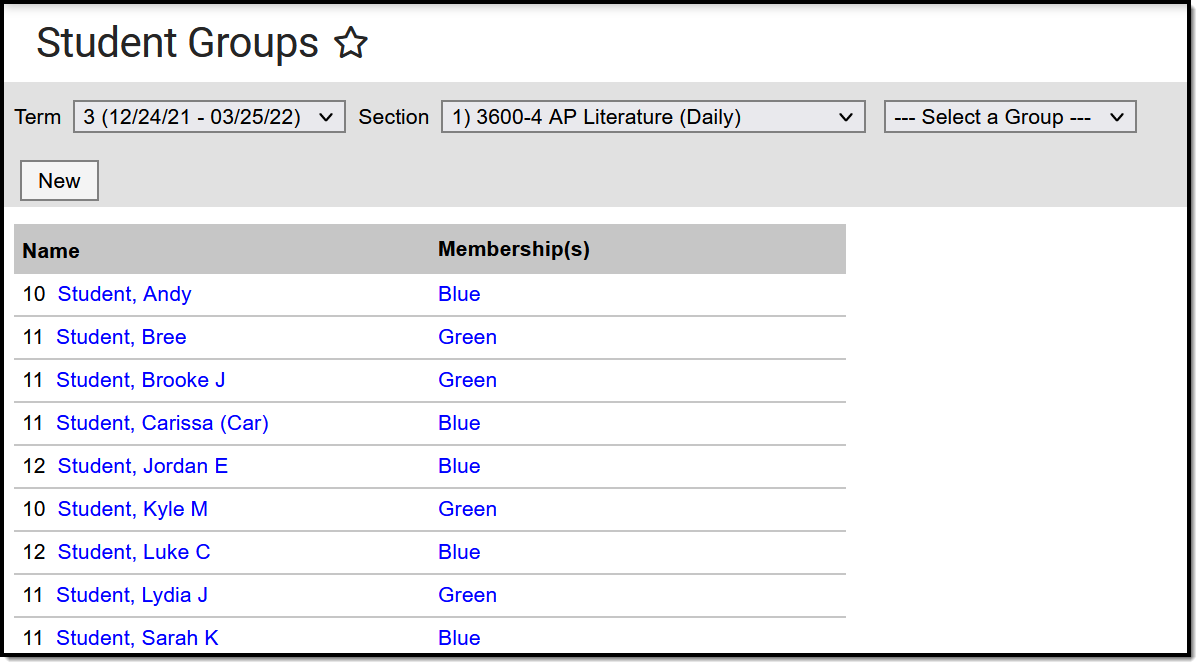
One such tool is the "Student Groups" option, which allows teachers to divide a class into small groups for an assignment or to simply have as a record to refer to for classroom activities. For example, you might create a roster of accelerated students who might benefit from more challenging small group work into a "Green" group, as well as students who need more support during reading into a "Blue" group. 

One big selling point, aside from the ability to quickly group students and create rosters, is for GMS/GHS teachers to adapt their gradebook at the same time:

"You can use student groups to give assignments to only a subset of students in a section. Once a group is created, you can select it in the Scheduling/Grading Alignment area of an assignment. The assignment only appears for the students in the selected group; all other students are automatically marked as exempt in the Grade Book."
You wouldn't need to take the time to duplicate the assignment or mark students as exempt--talk about a time saver! What's also great is that the differentiated assignment The link to the directions for Student Groups is here, though keep in mind you will have to login with your Infinite Campus credentials to access.

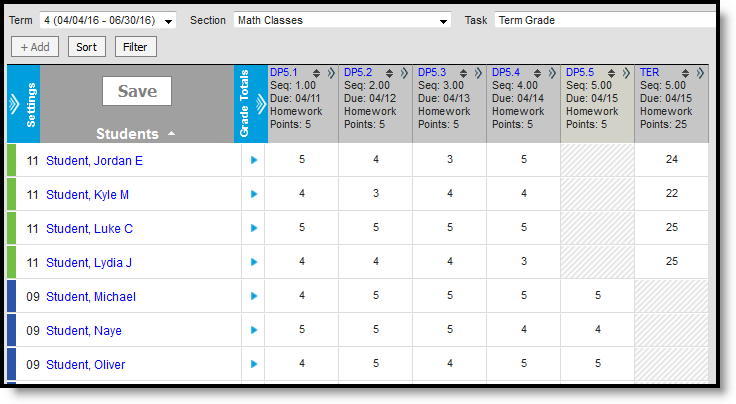
You can also save time adding assignments in gradebooks that cover students in the same course by using section groups. Infinite Campus shares that "groups make scoring assignments easier by combining matching assignments into shared columns in the gradebook."
As you can see in the image to the left, the teacher in this example grouped all his math classes into a section called "Math Classes." Instead of toggling between gradebooks, he can create the assignment once for all of those groups, and then he can select that section to score all at once. You can see that the different class sections are denoted by colors (green and blue) on the left hand side.

The link to the directions for Section Groups is here, and again, you will have to login to Infinite Campus to access the directions, with the linked video tutorial and simulation at the bottom of the page.

Finally, you can modify due dates and details for groups using either of these section tools (and for individuals too! See this video for a how to.). 

Want support for setting up student groups? Contact _GPSTLI@griswoldpublicschools.org

Thursday, March 9, 2023

Have you visited the TLI Website lately?

NWEA MAP season is almost upon the teachers and students of Griswold, and that means it's time to dust off that handout reminding you about how to administer testing. 

But if you lost your handout, remember that there is another way to access not only those directions, but tutorial videos and other resources of value: the TLI website!

GPS staff can access a wealth of resources that are specifically targeted to our teachers and support staff (often with student support materials too!). And while the homepage might largely look the same, updates are made regularly to each page, with new resources to support curriculum, instruction, templates for blended learning, and support for SBAC IABs and NGSS Interim tests as well. In fact, coming next week are some tutorials for downloading your data and using Excel or Sheets to quickly analyze it. Templates will be shared too!

It's worth setting a reminder to check the TLI website for news and updates every month or so. To find out what's new, in addition to looking at the instructional spotlight, you can click on the "News & Updates" tab to see what's been updated (and to see the archives of the Spotlight, so you can clean out your email). 

What kinds of resources are you looking for? Add a comment below, and the TLI team will respond!

Friday, March 3, 2023

The Triple E Framework: Is it worth it?


Whenever a new educational tool comes out, we're often asked by teachers if it is worth it.

And that makes sense. It usually takes at least some time and effort to learn a new tool, and if a teacher not only needs to learn it, but to teach it, then that tool better be worth the time investment.

But often times, knowing if a tool is worth it or not has more to do with the teacher/student needs and goals than with the tool itself.

A recent ISTE blog post made the point that,
"Technology, when integrated seamlessly, should make teaching and learning easier to access for both teachers and students, and when it doesn’t, then everyone suffers."

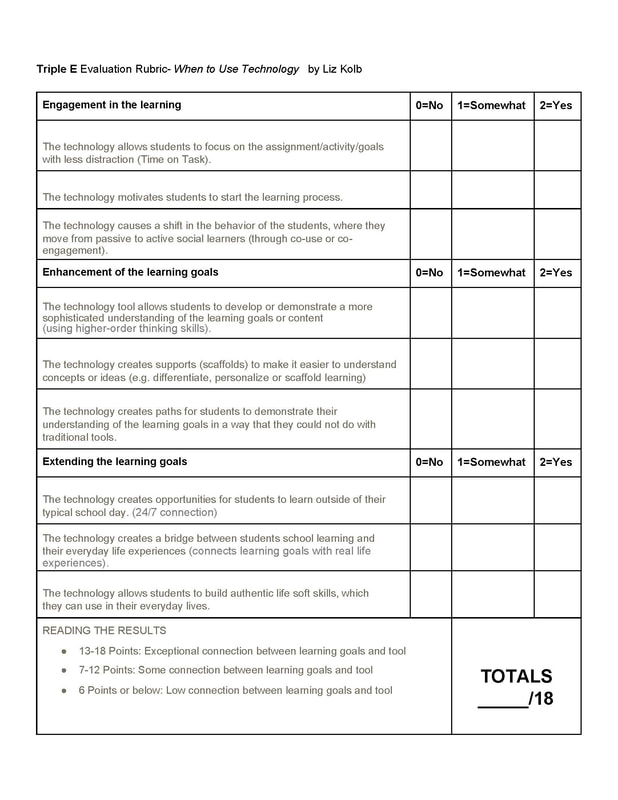
At the latest ISTE (International Society for Technology in Education) conference, many people were talking about the Triple E Framework for evaluating how well technology tools fit into a lesson. The idea is that the learning target comes first. Then, the teacher considers how well the planned tool will help students engage with, enhance, and extend that learning goal. 

The framework is pretty simple to use, and the creator even made an online tool that allows you to quickly and easily evaluate your technology. Take a look, and see if this inspires you as you plan to use technology to level up your learning.

Friday, February 24, 2023

Innovation and Imperfection: Embracing B+ Work and Beta

Risk-taking is part of innovation.

But failure is scary, and frankly, people don't learn well from failure. Who really sees an "F" on something and then thinks, "gosh, I just need to grow more"? 

Plus, teachers don't want to fail when the well-being of learners is at stake.

But innovation doesn't happen without risk.

So how do we, as teachers, find the balance between soul-crushing perfectionist behavior and failure?

Recently, GPS educators from around the district met and talked about how scary it was to take risks and try something new, but also how powerful those risks were in terms of their growth as professionals. Blended learning techniques like playlists, incorporating new stations like VR, or using new tools all took time to plan--time that they were afraid might be wasted. Part of what made it work, they said, was planning--often with other teachers, for both time-saved and moral support--and being comfortable with embracing something that was less than perfect, knowing that they would learn what worked.

This aligns with what educators call the power of "teaching in Beta" and settling for B+ work. You cannot get a 100 on every task--who among us has never cooked a not-so-great meal or missed a spot when cleaning? Dr. Angela Watson reminds us that "perfect is the enemy of done":
If we make a task into something that’s hard work — something that feels like it’s going to be outstanding — that often makes the task feel overwhelming. It becomes something we build up in our heads: B+ work is not going to be good enough; a little effort will not suffice. This must be amazing! It must be mind-blowing! It must be as close to perfect as I can get it!
When we think this way about a task, working on it becomes very daunting. We raise the stakes and start to feel overwhelmed. Then we procrastinate, or fail at it and don’t meet our own expectations.
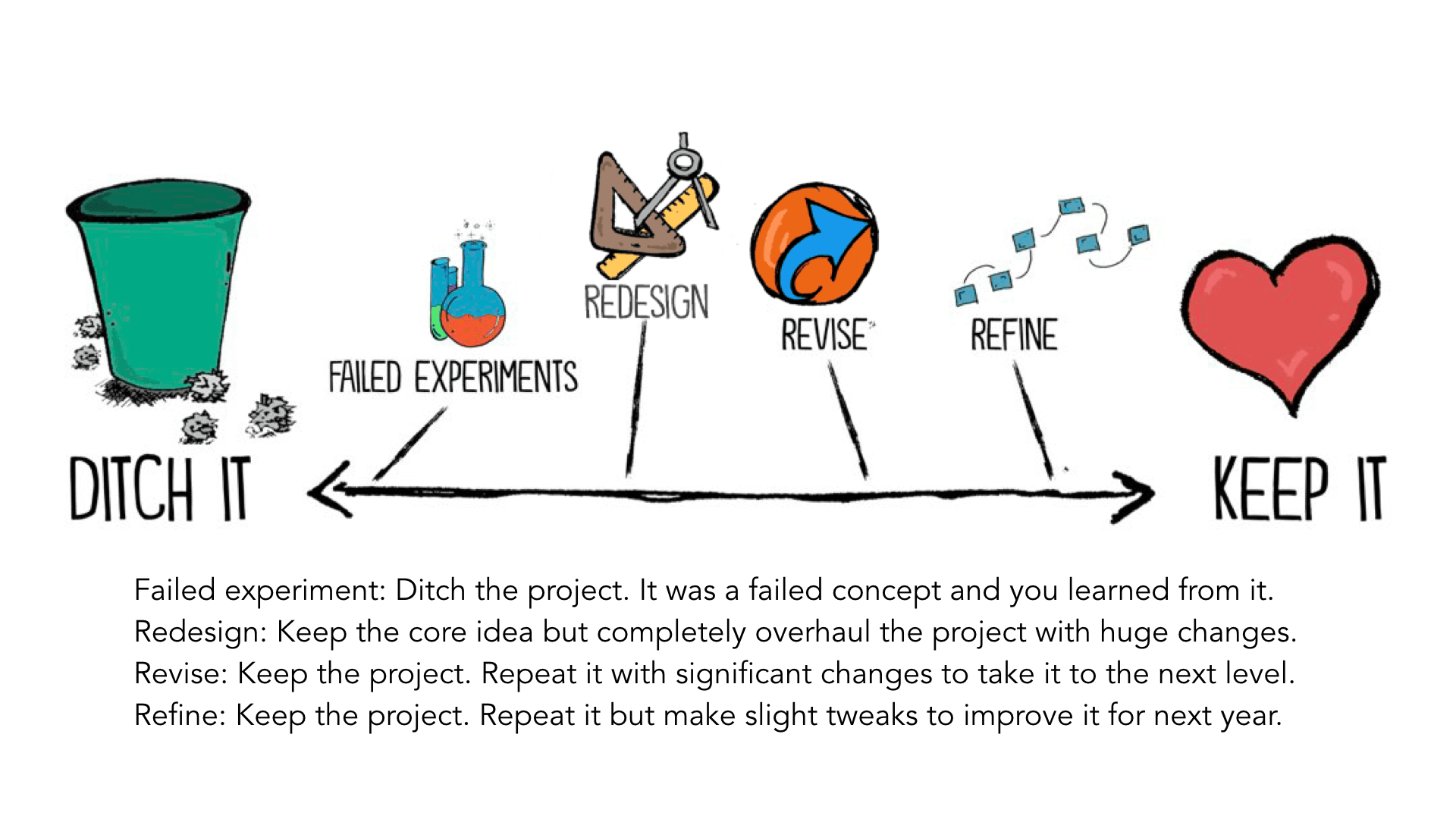
PBL expert professor John Spencer agrees that expecting things to go perfectly is the enemy of innovation, which requires iterations to grow. He advocates embracing the idea of viewing new lessons, projects, and teaching practices as being in "beta" form, like a new piece of software:
It’s the idea that you release your work in beta, knowing that it’s not perfect and perhaps it’s not even very good at all. However, you’re going to send it to an audience so that they can see it, experience it, and play around with it to let you know what you should do to improve it. This feedback leads to self-reflection, where you ultimately change your design and then release a new version. As you move through multiple iterations, you eventually reach a place where your work is pretty good. Eventually, it’s great. But you never stop creating those iterations. You always experiment.
With this in mind, we urge you to give yourself permission to aim for a B+. It doesn't have to be perfect, and it will require reflection, but it's the only way to grow. 


Friday, February 10, 2023

Can you smell what the podcast is cooking?

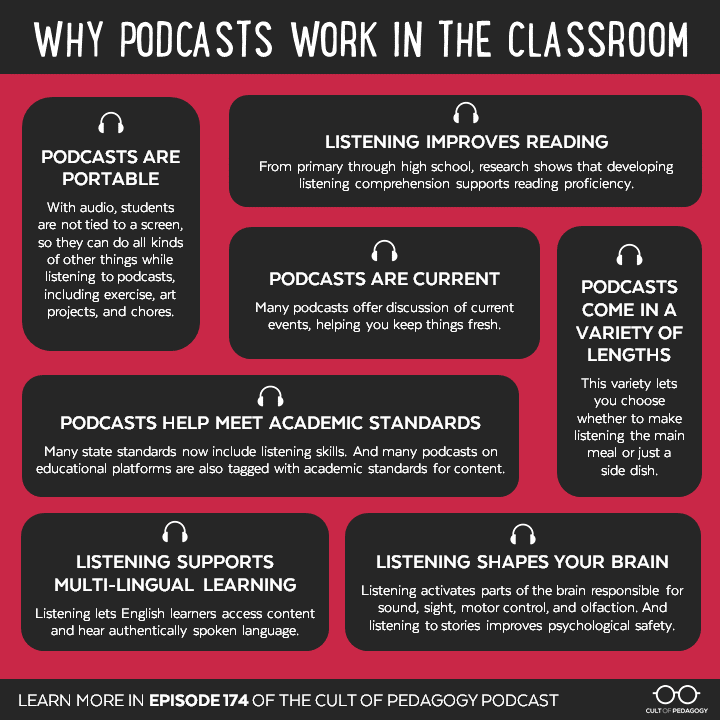
Science suggests that as you listen to a podcast or radio show about cooking and you hear the sizzle of the stove as the broadcaster describes adding garlic, the smell center of your brain will light up, activating memories and prior knowledge. You might actually SMELL the food cooking. 

https://www.cultofpedagogy.com/podcasts-in-the-classroom/


Audio, and podcasts in particular are powerful in the classroom for so many reasons:

Other benefits? You can often speed them up, slow them down, or use tools that read along with transcripts to increase accessibility. TED Talks on the TED platform include transcripts in multiple languages, which highlight as the speaker talks.

How can I use them?

  • There are many short (under 5 minute) podcasts for kids. These might be a great warm-up once a week, with the class working on retelling, identifying key information, or just brainstorming questions about a topic or current event.
  • You might use longer podcasts as part of a station rotation to build prior knowledge or provide more first person, non-fiction accounts of events.
  • You might use podcasts to appeal to different learning modalities, giving kids the option to listen to sources rather than simply reading all of them.
  • You can create IAB-style comprehension questions to help students practice for the listening part of the SBAC test, and discuss the techniques students used during listening. Kids can listen and discuss  individually, in small groups, or as a whole class.
  • You can use them to model, guide, and have students practice the note-taking skills you teach.
  • Have students write (or use flip to record) the connections they make between the current events from the audio to the historical events, general science topic, or other concepts they are learning about.

For links to elementary-age podcasts, check out this resource.

For more research, check out the Cult of Pedagogy blog/podcast about using podcasts.

For more ideas, listen to or view the video podcast from Truth for Teachers.


Friday, February 3, 2023

Supporting Student Digestion (of Content)


In Catlin Tucker's recent episode of her SEL series of the podcast, The Balance, she talks about how important Self-Management is to student development, and how vital it is that we provide students with opportunities to make choices.

One research-based and easy way to do this is to provide students opportunities to monitor their own progress through checklists. Chunking big assignments into smaller pieces is often a recommendation on individualized student plans, and this makes sense: just as we wouldn't do well shoving a whole candy bar in our mouths at once, our students won't digest the task well if we ask them to conceptualize it all at once.

Additionally, education specialist Dr. Kathleen Dudden Rowlands believes checklists are more than just a way for students to stay organized and on-task: 

"Metacognitive research consistently suggests that students who know how to learn, know which strategies are most effective when faced with a problem or a task, and have accurate methods of assessing their progress, are better learners than those who don't."

So what to do?

Option 1: Provide Assignment Checklists

If you already know the steps to take for students to successfully tackle a task, why not give them a checklist? Many teachers do this for longer assignments anyway, but this can also be valuable for daily assignments. This can even be done "on the fly" for individuals in need.

Option 2: Support Students in Creating their own Checklists

Not only is breaking tasks down an important life skill, but it helps students grasp the scope (and best sequence) of the task at hand. You can scaffold this by providing a partial checklist, with students brainstorming minor tasks under a major heading, or even by creating the checklist together as a whole class or in groups. 

If you want a lesson plan idea for supporting students in breaking down directions, check this out. If you want to support students by using technology, be sure to include some time to model the tool!

Technology tools to try:

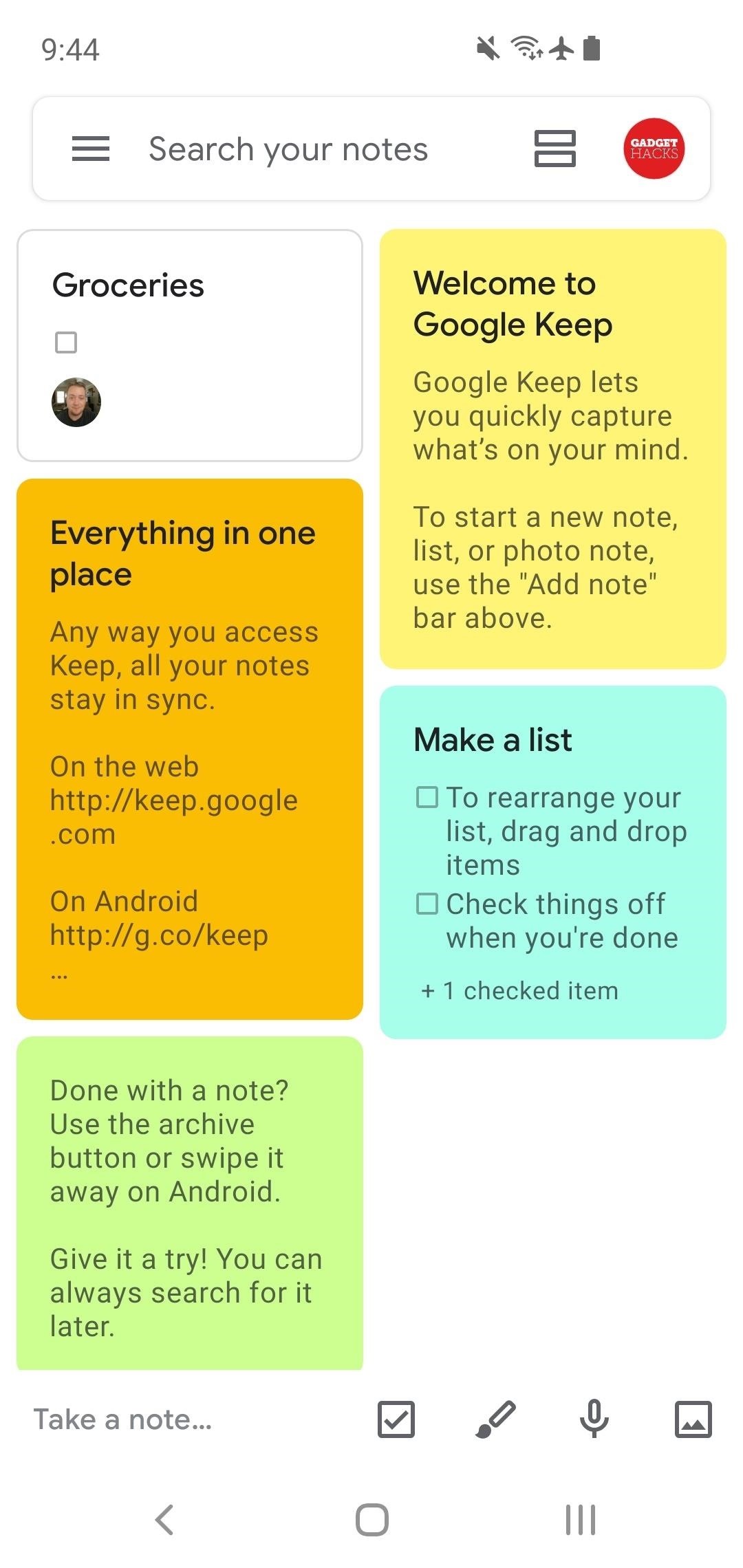
Are kids mobile? Kids can use Google Keep, which is great for use on computers and mobile devices, quickly saving content, and collaboration. (Learn more about using Google Keep with students at ShakeUpLearning.)

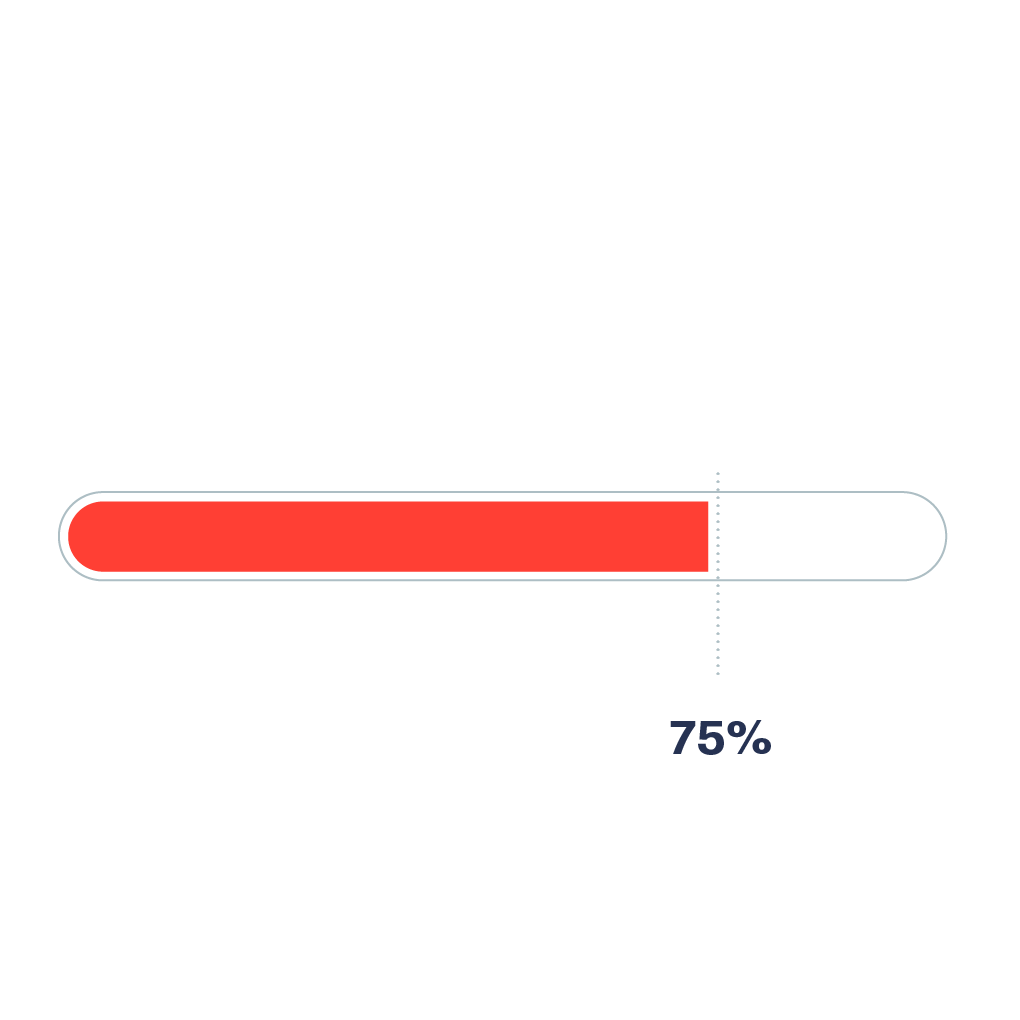
Is the task big? Students might also use Google Sheets for a more involved project. Each part of the task can have its own tab and set of checklists. TLI also has some templates that you can provide students that cross items off the list when the box is checked AND show progress in a progress bar.

Want to keep it really simple? Google docs has also just made it easier to create and use checklists, which allows for students to check and cross out items (or uncheck, if they realize it isn't done). Check out the 2 minute tutorial below that shows a few ways to make checklists!


A note about behavior: Do you have students who might benefit from an academic behaviors checklist? Enlist them in creating their own self-management goals for the day with this tool from Intervention Central.

Friday, January 27, 2023

Take Time to Save Time: Planning to use Rubrics and Success Criteria

In a recent conversation with a team, the topic of rubrics came up. Several teachers shared that they weren't sure it was a good use of their team time and effort to put details into a rubric that students don't use well.

And this raises a good question: do we always need detailed rubrics?

Well, the short answer is, no!

But research suggests that having clear success criteria--and in cases where a skill recurs, develops, or is reviewed for a long period of time, rubrics--is powerful:
So how can we make this easier on teachers and on our time?

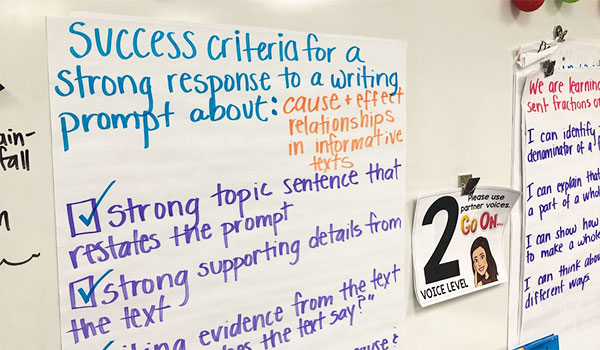
1) Have clear learning targets for the assignment, and share them in student-friendly language.

One big concern teachers share is that students can't or don't accurately monitor their progress or provide accurate feedback to each other. The more "targeted" and clear we can make expectations for students, the more likely they are to hit that target.

“When students understand exactly what they’re supposed to learn and what their work will look like when they learn it, they’re better able to monitor and adjust their work, select effective strategies, and connect current work to prior learning.” (from Brookhart and Moss “Learning Targets. On Parade” Educational Leadership, October 2014, v. 72 p. 28)

2) Use models to help build success criteria.

There is power in SHOWING, not just telling, what we are looking for. In fact, for bigger assignments, this can be done as a co-construction activity, in which the teacher shows examples of what they are looking for and asks students to identify what made the work successful. In this way, students "own" the drafting of the criteria for success

This can even develop as a checklist! This checklist can become the core of a rubric, or students can use those criteria to review their work during and after it is created.

3) Build in time for students to use them.

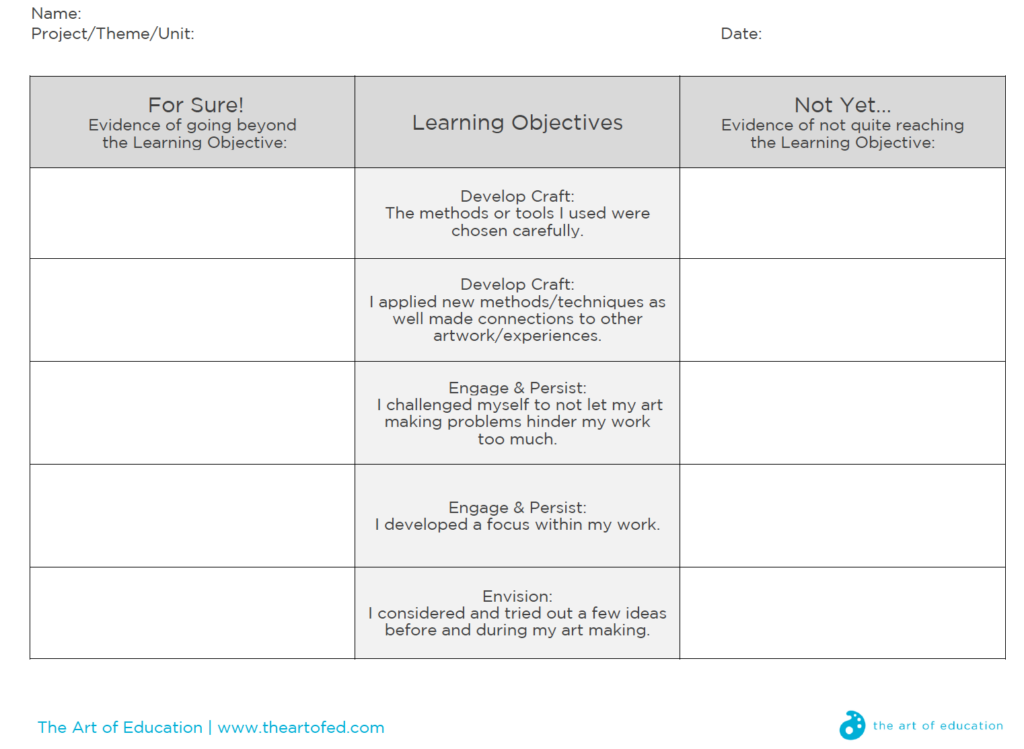
Giving class time for students to use a rubric or checklist to review and revise their work is tough--after all, there is a lot to cover in that precious time! But if we want to make sure students feel more success the first time, and to save ourselves time reteaching (and taking home assignments to write feedback on!), this is time well spent. One way to engage students is to use a single-point rubric

Not only does this save time in creating a big, detailed rubric, but it provides the student (and teacher) space to provide specific feedback on how the student work does or doesn't meet the criteria. This can be a formative assessment, as students who can't or incorrectly identify evidence that they meet the success criteria are good candidates for reteaching, while those who can identify why they aren't yet meeting success may be able to improve after self-reflection. 

Make time to save time

It seems counterintuitive to plan more class time to review learning targets, co-create success criteria, and spend time using a rubric, but that time is shown by research to be well-spent. Students show greater understanding and success, and teachers do LESS of the work in the long run. It's a win-win!

Friday, January 20, 2023

Should students sit in rows?

This week's blog post by teacher author Dave Stuart Jr. tackles a question that has been making the rounds more recently as people compare the classroom environment of compulsory rows that COVID protocols demanded to other seating arrangements: should students sit in rows?

Spoiler alert: His answer is, it depends.

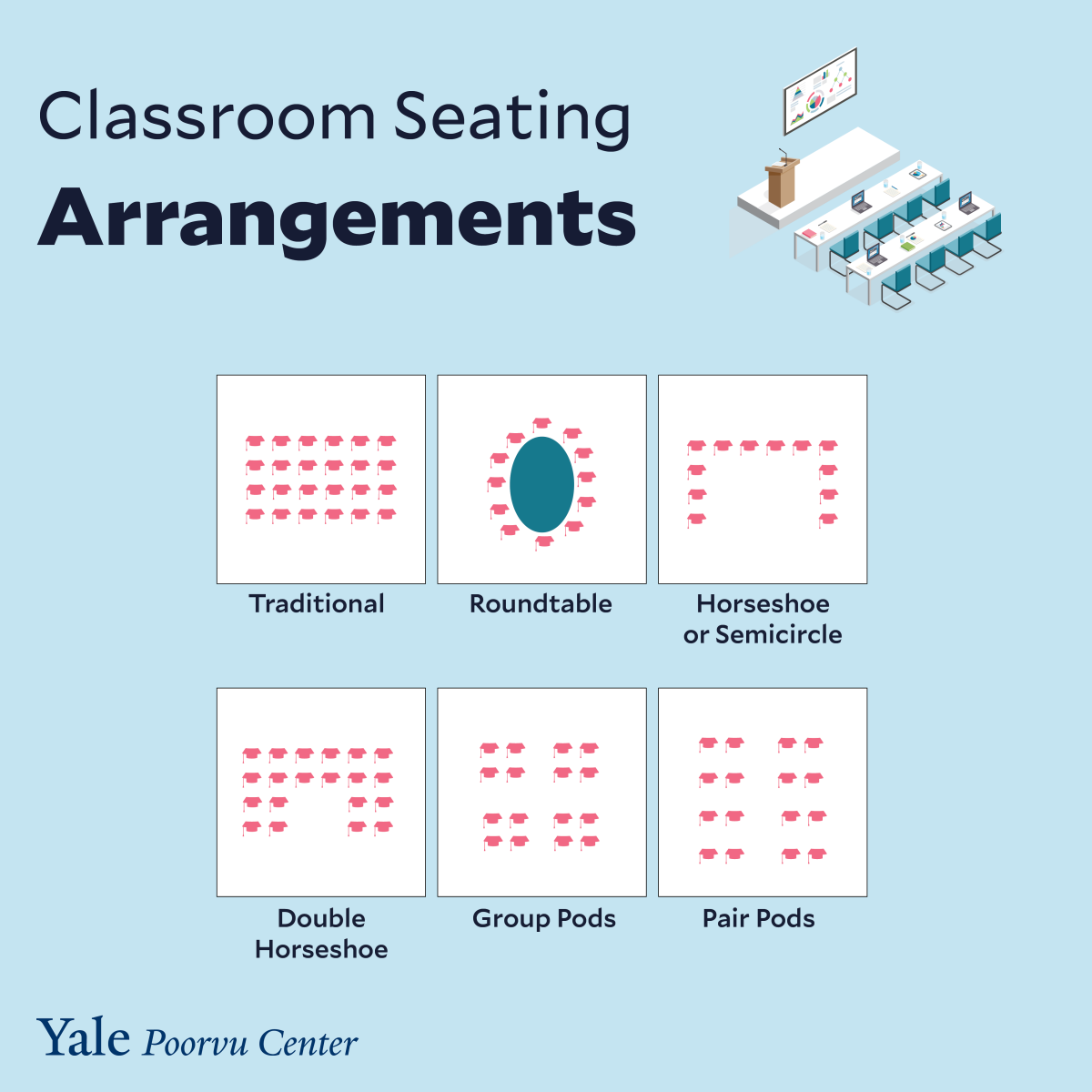
In the post, he discusses two seating arrangements: one, is paired rows, with students always having a seating partner, but more or less in columns and rows, and the other is desks grouped into four, all facing each other. He makes the point that by comparison, rows provide less distraction during independent work and a clearer view of the board during direct instruction. And of course, research and common sense supports this.

But the post, while pointing out that other seating arrangements may be more beneficial in situations requiring more collaboration, fails to explore any other options, such as the horseshoe or circle, and research, suggests that "'the most effective way to organise a classroom is to be as flexible as possible with teachers regularly moving furniture to suit the activities' (Maddern, 2011) – for example, Harvey and Kenyon (2013) found that students tend to prefer more flexible seating arrangements.

It won't surprise any teacher that research has shown that classroom seating impacts "student learning, motivation,  participation, and teacher-student and student-student relationships (Fernandes, Huang & Rinaldo 2011)." What might be more surprising is that recent research suggests that the set-up of the classroom actually impacts the TEACHER and her pedagogical choices as well; according to the Poorvu Center for Teaching and Learning at Yale

For example, a classroom with seating affixed and directed toward a podium at the front of the room results in instructors spending more time in lecture and students demonstrating less active engagement. In contrast, roundtable seating arrangements lead to instructors and students engaging in more active learning activities, resulting in improved learning outcomes (Brooks 2012). 

So what is the answer? It depends. If you are delivering direct instruction, then a clear, unobstructed view of the instructor is best in that moment. However, if you want students to collaborate, seating them with other students is key.

And even with traditional desks, teachers can try to get the best of both worlds. Recent research on elementary seating arrangements supports the horseshoe seating arrangement with flexible seating (i.e. chairs and triangular desks that reconfigure easily). For those with "traditional" desks, the pair square (alternately known as the pair pod) is a style of flexible seating arrangement that gained renewed attention: essentially, students are seated in pairs, but each pair has a pair in front of or behind that they can turn and work with to make a group of four.

What is clear is that if you are thinking of changing up your seating, think about your goals and how your physical space can match your pedagogy. Do you want to create more space for students to Think-Pair-Share? To debate? To collaborate? To create? Then rows might not be the way to go.

Tuesday, January 10, 2023

Mindset, Behaviors, and a Routine

January is a turning point for new and veteran teachers alike. For some, the end of a term brings new classes. For others, this is the point at which a lot of hard work really starts paying off.

What can make the difference is mindset--both the mindset you hold (i.e. it's going to get good!) and the mindset you project (i.e. you guys are going to be great!). One key ingredient that helps both these mindsets is praise.

While we've written in praise of praise before, we really can't praise the power of behavior-specific praise enough. Both research and experience tell us that it is more effective to build positive behaviors than to control negative student behavior (Strain & Sainato, 1987). However, some people have said that it is tough to give more praise:

  • "I don't want it to feel fake."
  • "Kids don't want to be called out."
  • "I just don't know what to praise."
And research shows that especially by middle school, kids get good at knowing when praise is insincere. So how do we praise sincerely AND frequently?

It got us thinking about how can teachers can find it easier to give behavior-specific praise. Our thought, and the thought of educators like Todd Finley, is to make it part of a routine. You might use a clipboard with a praise checklist to keep track of who is praised and how often, but how do you know what to praise?

This is where you, the teacher expert in the room, come in: what behaviors do you value? If you want students to enter or transition around the room quietly, consider putting quiet movement on your checklist for the week. If you want students to raise their hands to share, you might put that on your checklist for the week. And as for academics:


If you are looking for a planning sheet, this resource is great for developing your initial plan for behavior specific praise. TLI has made a template that you can choose to copy and adapt for this purpose. If you want help designing your own behavior checklist (or adapting something you currently use in the classroom to include praise), contact us!

Thursday, January 5, 2023

Technology Hacks, Especially for Littles: Use Audio, Video, and Pictures

A few teachers have mentioned a stumbling block for using powerful formative assessment tools are that their learners need more supports. Lots of written directions won't help emerging readers. Having to type a lot won't work for students still learning keyboarding. 

But oftentimes, these roadblocks can be overcome! The benefits of using the technology are great, and with a few tricks or hacks, teachers can speed up the process and reap those benefits. Here are a few, designed especially for younger learners or other students who might need more supports:

Issue: You want to use an online tool to assess students, but students don't have the reading (or perhaps typing) skills needed to complete the online assessment/activity quickly.

Idea #1: Flip

Flip, formerly known as Flipgrid, is a free tool that allows students to respond to prompts--either written or video--with audio or video. It also allows for students to give responses to the recordings of their peers, if the teacher chooses, and for teachers to give recorded feedback. Flip includes quiz tools as well as many other ways to engage students in learning. 


Flip has Immersive Reader built in, which can read text out loud, and Flip has enabled more supports to help younger learners record their voice and/or video response. According to these PreK-2 tips, teachers can use QR codes to support student sign-in to topics. If this sounds like something you are interested in, TLI would love to help you realize your vision!

Idea #2: Google Forms

Google Forms are one example of a powerful tool for formative assessment. Google forms allows you to insert video, which is great for sharing audio and visuals. It also allows you to use pictures as answer choices, which is especially powerful if you just need students to give a prompt a Thumbs Up or Thumbs Down. You can also use the MOTE chrome extension to easily add audio to quickly record yourself OR to have students record themselves giving a longer answer.

Idea #3: Mote

Note that you can also use MOTE to allow students to record themselves in other Google documents, like slides, as in this example of a See-Think-Wonder activity (click to access the demonstration and slide template). Although GPS currently only has the free version of MOTE, which limits recording, the tool has a lot of possibilities for quick and easy audio recording.

BONUS: You can use the MOTE extension to create guided reading experiences (which might be faster and easier than creating audio with media creation tools like Screencastify). The video below shows how this audio tool can be used in 4 different ways to support learners, with the focus on upper elementary or secondary learners who might need more supports:


What tools do you use to make assessment more accessible and flexible for your learners? What challenges do you foresee having to work through that others might have solutions for? Let us know in the comments.

Tuesday, December 13, 2022

Timers, Trauma-Informed Teaching, and Tiny Steps

December is "the silly season," when kids get silly for two reasons: 1) excitement for the holiday break and 2) dread of the holiday break.

Our students who have experienced or continue to experience trauma often have a different set of feelings about the holidays. The break is often unpredictable, lacking the routines, resources, and other safety found in school. Students experience more stress and in anticipation of the break, they are more likely to show the 4 Fs of stress response: Fight, Flight, Freeze, or Fawn--the last term implying the student clings tightly to the teacher and is overly dependent upon that praise. 

On a recent Melissa and Lori Love Literacy podcast, Dr. Melissa Sadin spoke in praise of timers as a strategy to help students who are being extra dependent or needy. In the example, the hypothetical student, Doug, can't/won't start his assignment because he perceives that he NEEDS the teacher by his side. The teacher then deploys a timer, starting small (i.e. 2 minutes) and asks Doug to take a small step, like writing his name on the paper and reading the directions, promising to return when the 2 minutes is up to check in. When the 2 minutes is up, the teacher returns and praises the progress. This timely behavior-specific praise (another proven strategy) gives the student the reassurance they need in a small dosage, while allowing the teacher to work with others. Then the teacher asks Doug to take another step, and sets the timer for 2 more minutes. This chunked process builds trust, as it reassures the student that the teacher will come back. This helps develop student executive skills, and eventually, will allow more time to be planned between check-ins.

This "predictable positive attention" strategy (Minahan, 2014) to create safety and discourage students from seeking attention through less desirable behaviors is reinforced in the research, as shared in the 2019 ASCD article on Trauma-Informed Teaching Strategies [Warning, clicking this link will cost you one of your free articles for the month! You can ask TLI for a PDF if you want to save up]:

During independent work time, if a teacher says to a student "Great work! I'll be back to check on you," the student has no way of predicting how long they need to wait—and from past experience they know that the teacher may forget to return altogether. Using predictable positive attention, however, the teacher can say, "I am going to check on you in 10 minutes," put a timer on the student's desk, and add, "Come tap me on the shoulder when the timer goes off." If the teacher has many students in the class that could benefit from this, she could transfer the strategy to small groups: "I will check on this desk group at X time."

Research shows that using timers, agendas, and other predictable structures helps all students. Not knowing what is coming next can put anyone on high alert, so providing visuals (as with slides or ClassroomScreen displays that allow for multiple timers) and previewing any changes to the normal routine can help.

As you navigate the middle of the year, think about how you might use timers to help structure your class and support individual students. Sharing in the comments and with your colleagues is a great holiday gift!

For more background on Trauma-Informed Practices, check out this Edutopia video:


Friday, December 9, 2022

Pass the Vocabulary

This week, in speaking about the importance of building knowledge and teaching vocabulary as part of the science of reading, we were reminded of a favorite activity of students and several GHS English teachers: the "pass the vocabulary" story. Here's how it works: 

  1. Using a given word list, each student would take a blank piece of paper and write the first sentence(s) or a story using one of the words correctly. (TIP: Have students highlight or circle the word, to make it easy to know what was used!!)
  2. After the given time (1 minute), they passed the paper to the next person.
  3. The next person would write the next sentence(s) of the story, using a different vocabulary word.
  4. The process of writing and passing would continue until time came for all the words to be used.
  5. At the end, students would take their stories and join a small group, which would share the stories for peer review for meaning, revise, and then share out the "best" story from the group.
Students LOVED this activity, as the stories often got very silly by the end, and it was a great challenge. They also loved that they had a chance to discuss and revise the stories, as it rewarded their growth. And teachers, well they loved that students had to discuss, correct themselves, and collaborate in a low-prep activity that the students themselves helped evaluate. 

So, aside from being fun and easy, why is this valuable?

The science of reading makes it clear that pre-teaching vocabulary is important; students need to build knowledge, especially knowledge of words, to be more proficient readers. But this applies beyond students learning to read, and continues as students read to learn across the content areas.

Learning science also shows that memorizing a list of vocabulary words and their definitions for a quiz--especially a matching or multiple choice quiz--isn't a great indicator of how well students have learned words. Most often, students cram, storing these words in their short term memory, but not making the connections that encode them into their long term memories in ways that make the learning stick. Students, especially struggling students, need a dozen or more exposures to words and their meanings to fully learn them.

Research suggests that these things help students with vocabulary building:

  • Explicit instruction of words and their meanings increases the likelihood that young children will understand and remember the meanings of new words.
  • Higher frequency of exposure to targeted vocabulary words will increase the likelihood that young children will understand and remember the meanings of new words and use them more frequently.
  • Questioning and language engagement enhance students’ word knowledge. This can include retrieval practice, scaffolding from low-demand questions (i.e. meaning) to high-demand questions (i.e. how would you use...?)
Now, this means that students can't just start by writing stories. Teachers need to make time for explicit instruction, be it reviewing the words with students in context, or reviewing the roots or related words, or to support students in making Freyer Models or semantic maps/word webs. But beyond that, students need time to work with the words.

But what if I don't want my students writing stories.

Another group activity that was relatively low prep was a card sort. Have student groups make index cards (or cut out card sets) of the vocabulary words. Then, have students organize them into 3-4 categories. This could be categories you provide, or categories the students create. They then have to explain why the words belong together, and how they relate.

Here are some other ideas:

  1. Pass the Parcel: Review vocabulary in whole group or small group with a game-like atmosphere with some bags full of vocabulary.
  2. Paper Plate Match Game: Have small groups cut paper plates in half, and write the word on one half and on the other, write a definition, synonym, antonym, example, etc. (whatever serves your purpose). Then have them shuffle them up and find a match.
Want more? Check out these ideas from We are Teachers and Gifted Guru.

Friday, December 2, 2022

But What if It Works?

There are a lot of misconceptions about personalized learning, like that this means we need to make a plan for each student each day. In reality, personalized learning can often be accomplished when we find ways to give students voice and choice. 

But this is easier said than done.

As the district moves ahead with blended learning and student-centered instruction, we have heard many teachers express very real concerns about using models of instruction that call for more student agency and choice regarding the pace, topics, and methods of learning. 

  • What if students don't do the work? 
  • What if we have a technical glitch?
  • What if they can't finish in time? 
  • What if they lost their Chromebook charger?
  • What if I don't get the time I spent making instructional videos back with less time reteaching in the classroom?

But also, what if it works?

In a recent Podcast (which you can access with the accompanying blog post at this link), John Spencer shares:

Whether it’s a Calculus teacher in Australia or a first grade teacher in Hong Kong, we all have a certain level of fear of letting go of control. I’ve written before about the fears I had in empowering students with voice and choice and I thought I would share these fears here again. What about the noise level? What about classroom management? What will the principal think? Will we actually cover all the standards? How will I assess the learning?
But, honestly, each of these fears was a subset of a larger question. What if it fails?
As a new teacher, I was so consumed by the question, “What if it fails?” that I never even asked, “What if it works?”

What does this mean for my classroom?

Whether you are trying a hands-on, inquiry/project-based approach to a topic or you are thinking about how to change up your classroom structure, keep in mind that there is power in TRYING. While every minute with our students is precious and we want class to be perfect, we can give ourselves grace as we grow.

Positive risks are necessary for personalization.

There are so many reasons to take positive risks and use "versioning" in our classrooms: 

  • We model for our students that it is not only okay, but normal to try new things and accept some level of failing as part of the learning process. 
  • We grow through the process, and we find better ways of "doing" the work of teaching that sustain teachers and meet the need of students.
  • Great, unforeseen opportunities often arise from risk-taking.

So start with one project. See how things go. Share with students if you perceive things aren't going well, and have them help brainstorm solutions for version 2.0 of the assignment. For as Robyn Shulman shares in "10 Ways Educators Can Make Classrooms More Innovative":

By giving students real-world problems to tackle, fail and try again, we are telling students that their voices matter.


Wednesday, November 16, 2022

Dicebreakers: Using Virtual Randomizers to Foster Collaboration

At this week's TLI Committee Meeting, the team highlighted ClassroomScreen as a tool worth using. While we've written about ClassroomScreen before, recent discussions with teachers have highlighted a few needs that this tool can meet with very little effort from teachers. (For more, check out the updated TLI EdTechResource on ClassroomScreen.)

But the real story is that in checking out the ClassroomScreen twitter account, the team stumbled across an engaging idea with many ready-made templates that is EASY to use to foster student collaboration, critical thinking, and bonding: dicebreakers.

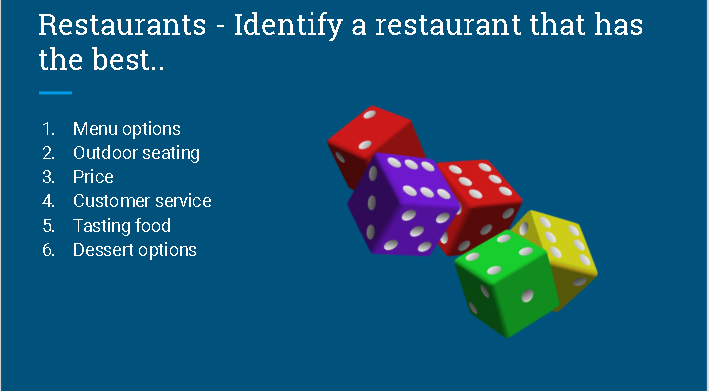
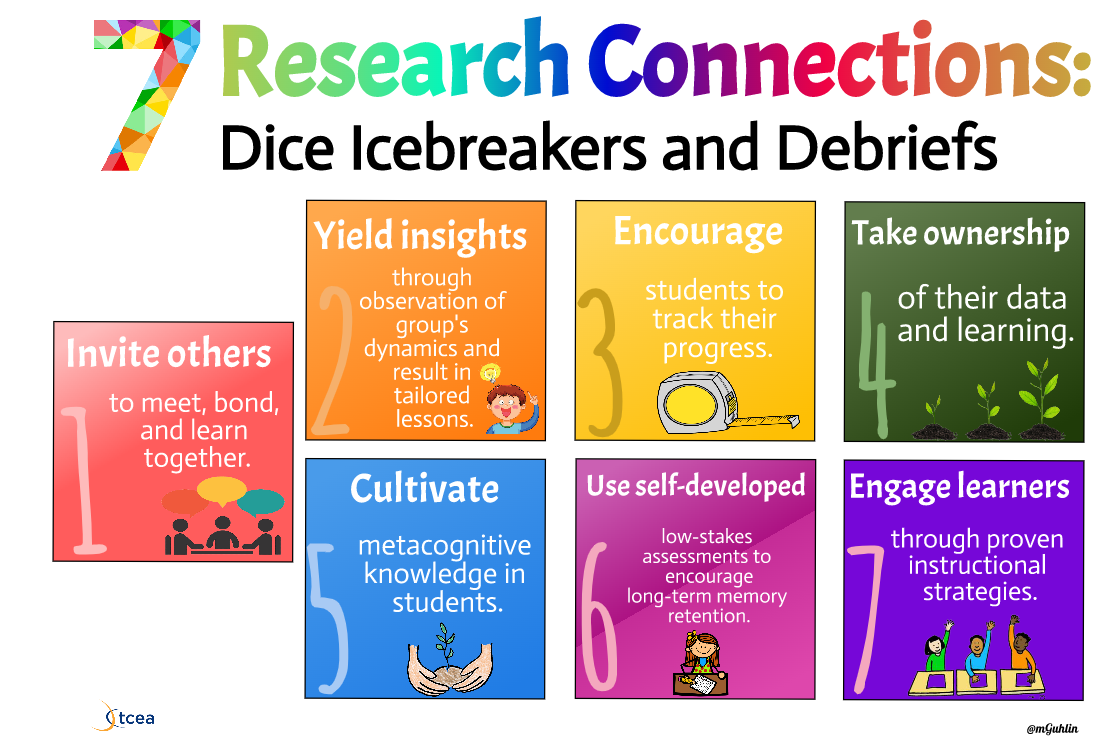
There are many icebreaker resources available online that use dice to spice up getting-to-know-you activities (like this free template), but the TCEA blog showcases many other ways that dice can be used to get students talking and working together. Essentially, dicebreakers allow students the opportunity to brainstorm and talk through their ideas about different parts of a topic without having to discuss the same concept. Using physical or virtual 6-sided dice, this activity provides six different, yet related, talking prompts that encourages in-class discussion. This could be unrelated to content, as with a traditional icebreaker, or it could be related to your business unit!

But the TCEA blog highlights other uses for dice activities that include ideas for debriefs and ready-made templates. Check out their extensive blog post and see which ideas you can use in your classroom next week.

Want more ideas for using dice in the classroom? Check out this post for using giant dice for whole class fun and this WeAreTeachers post for additional ideas to using dice to spice up ELA, math, and even music lessons.


Friday, November 4, 2022

Jamming with Jamboard

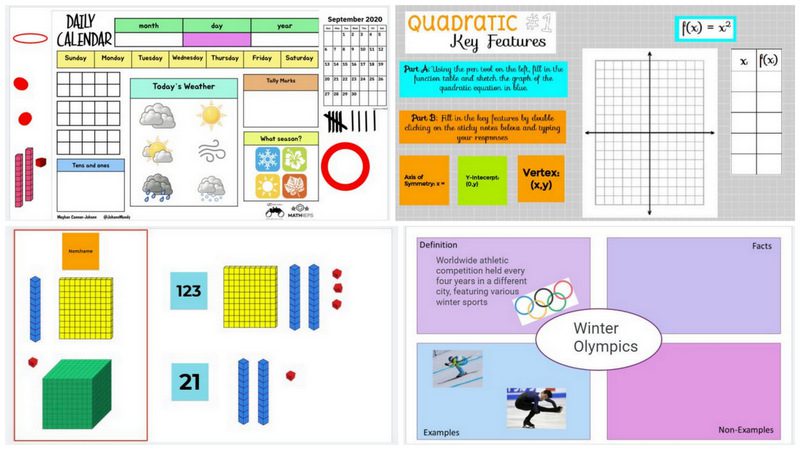
If you haven't had much experience with Jamboard, it is basically an online whiteboard that is part of the Google suite. It works well on your Smartboard, Chromebooks, and other devices, and you can learn more about it here.

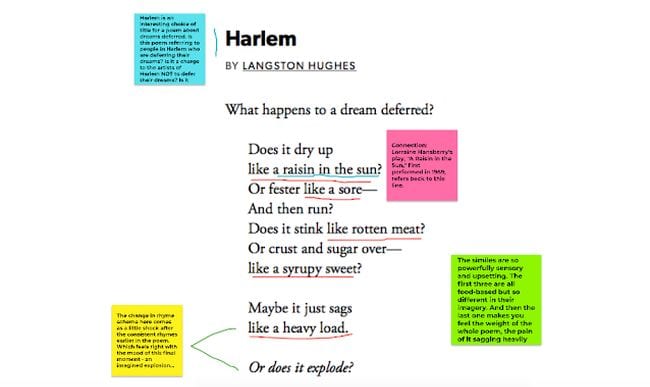
If you use Slides for many things, as I know many teachers do, then it would be logical to wonder why Jamboard would be worth learning and integrating. One compelling reason is the drawing functionality. Unlike slides, the drawing tools on Jamboard allow for easy annotation:

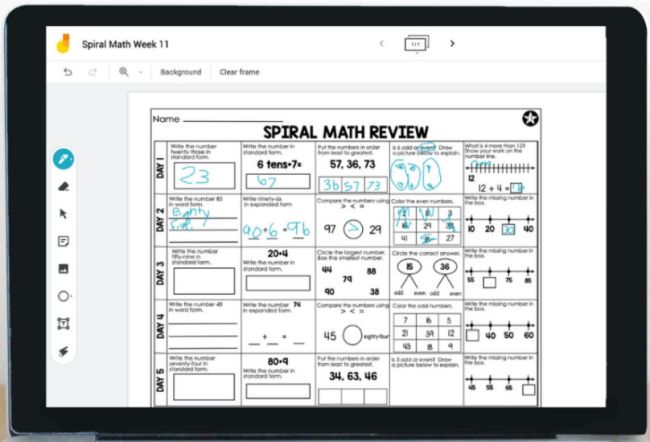
While this many not be compelling without a touch screen, if you have a Smartpanel, this allows you to take notes on a worksheet or picture without much more effort than pasting a screenshot or scan on the board:


Jamboard also allows you to keep adding new screens to a Jam, so if you wanted or needed to save and upload all the notes from class to Google Classroom, this process becomes a snap.

While many teachers don't recommend having the whole class on one Jamboard at the same time (no version history = less accountability), it is great for small group collaboration or organizing quick teacher-directed whole group activities.

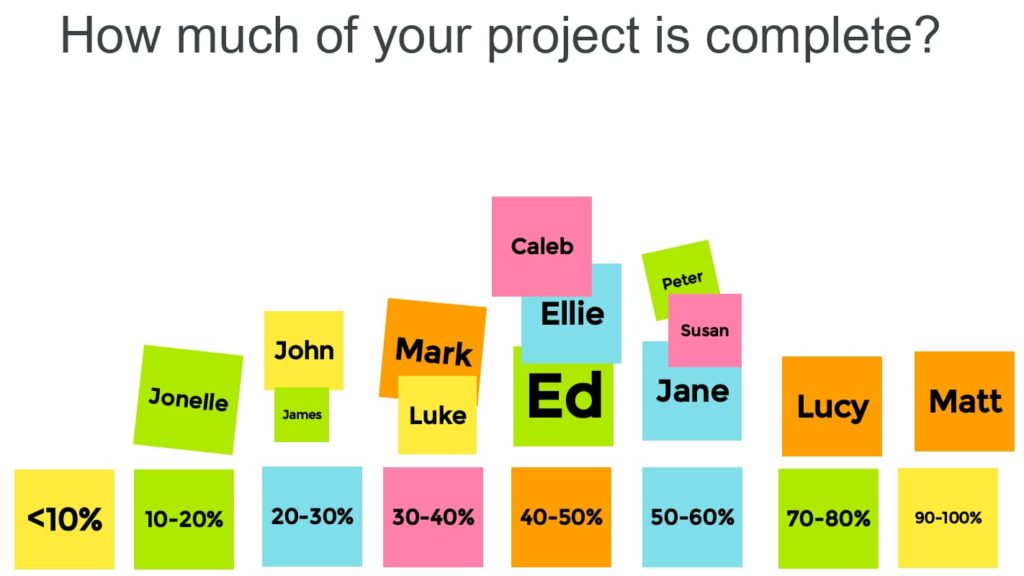
The sticky note function makes it easy for students to quickly contribute and organize ideas. This idea from Chromebook Classroom is so simple, yet it is useful for teachers as formative assessment data:


Jamboard makes it easy to manipulate objects on a screen, and if you check out this post from We Are Teachers and this post from Ditch That Textbook, you will find over 40 ready-made templates and ideas that will increase collaboration, manipulation, and accessibility. Why reinvent the wheel when someone has shared a Freyer model template or already made number cubes and calendar items?

If you are looking for something new, or you are just looking to save some time, check out the Jamboard templates that people are sharing.

If you want more ideas, you can also check out this free ebook from DitchThatTextbook with 10 Jamboard lesson ideas and templates.

Friday, October 28, 2022

WOW your Parents, Streamline your Practice

Parent-Teacher Conferences are coming up fast, and with so many options for connecting with parents, it helps to think about how you can use technology to streamline your preparation and leave your parents impressed.

Scheduling

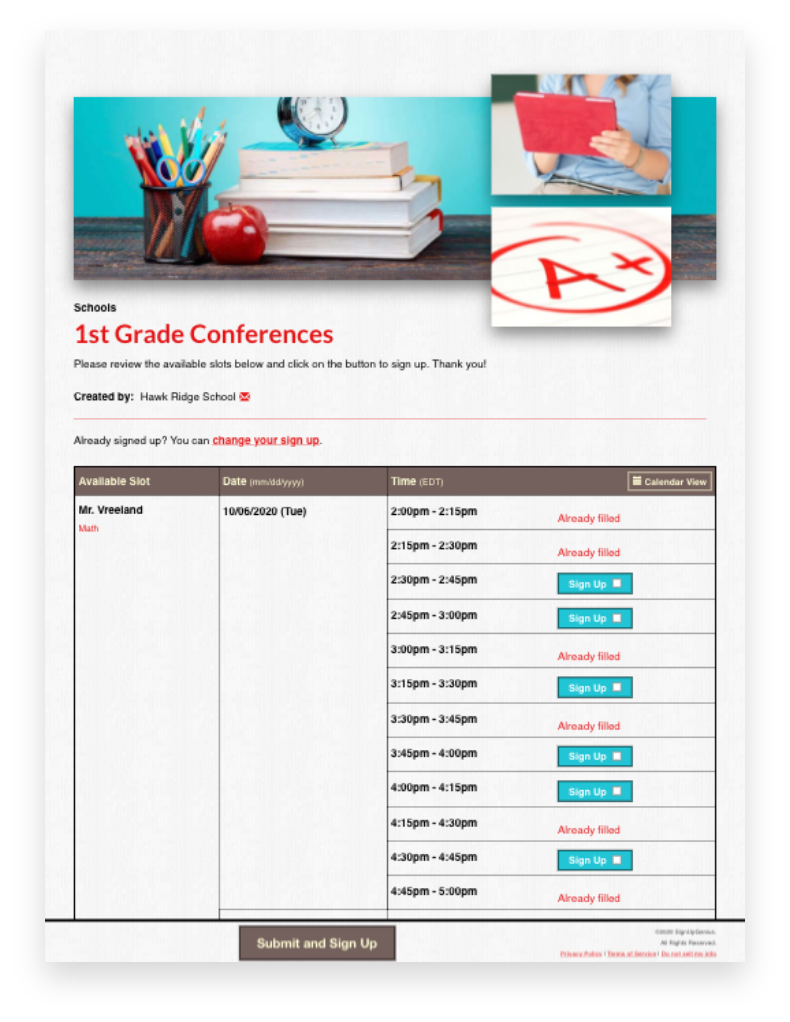
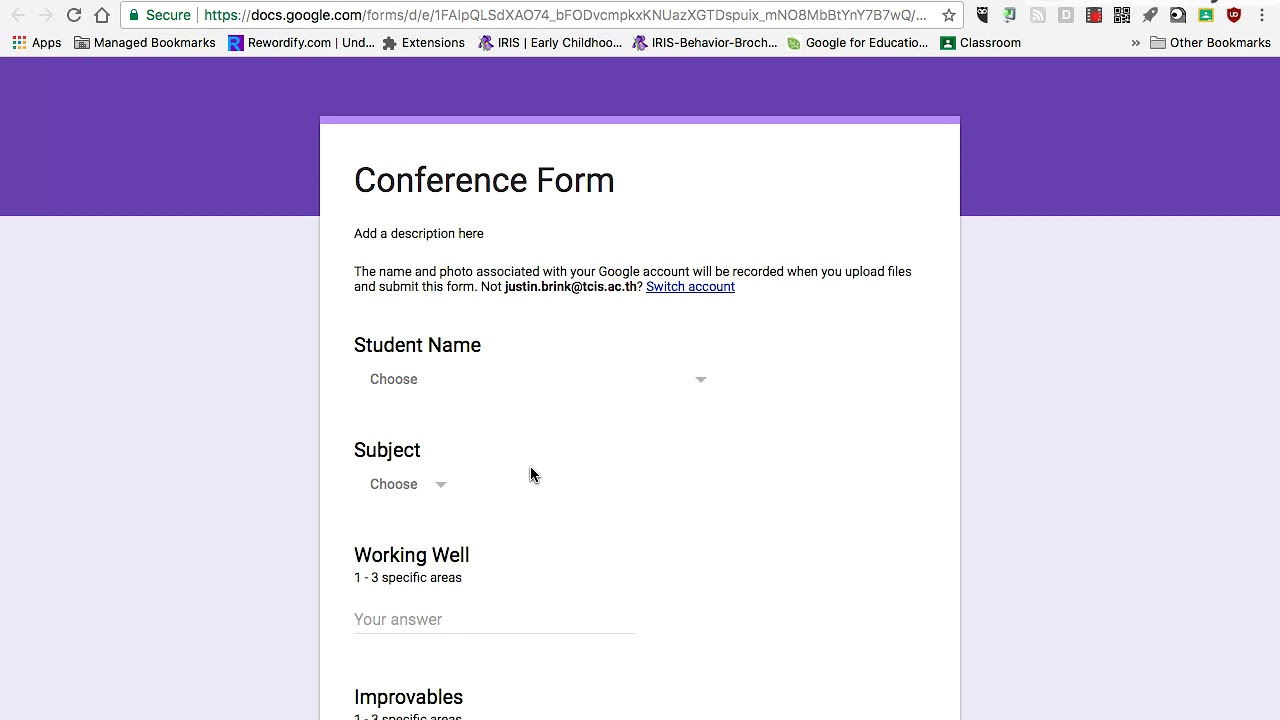
While Sign Up Genius continues to be a favorite for scheduling parent conferences, you can also use Google forms and Google calendar to set up appointments and share Meet links if parents are joining virtually. (For more on using Google forms with parents, see our previous post.) 

Online scheduling is great because it eliminates the "middle man" problems associated with sending papers back and forth. Additionally, using online appointments makes it easier for parents (and teachers!) to schedule, especially if they are coordinating conferences with multiple teachers. And of course, parents can always call/email and you can help them use these systems!

(As another a time-saving tip, printing out your electronic calendar or sign up is a great way to streamline sharing your conference log with your building administrators.)

Showcasing your Classroom

While open house is the best opportunity to allow parents to "see" what their kids experience every day, not every parent can make it. In advance of conferences, you can share insight into your class using digital tools. Several teachers have done virtual tours (check out this example from GHS!), which are not only great to record for parents, but also work great as an introduction for new students. 

And, if you want to empower your students and share the load, have a student tour challenge that asks your kids to collaborate to create a tour and/or compete to see who creates the best tour video.

Showing Student Work

Parents LOVE seeing what their students are doing. While some teachers may already have students creating Google Sites as part of a portfolio, others may simply have a paper folder of work. Some teachers have students complete a Google form or document that allows the students to choose what information they want to share with parents about their year so far. This is a great way to promote student self-assessment/metacognition and to increase parent engagement.

Some teachers have joined meetings with their phones, in addition to their computer, to have another camera to show offline work. One other great idea for sharing this with parents who are meeting virtually is to use a document camera. Especially when you have little learners who need to process a lot on paper, this allows you to talk about what you are seeing in student work with a visual reference for parents. (Click here for directions on using document cameras in Google Meets, or contact TLI.)


Supporting Parents

Some parents have a tricky relationship with school, whether because they are new to having students in the system, they have a language barrier, or they are carrying their own trauma from school. You might consider sending them preconference questions or materials to help them prepare.


Especially as students transition to new schools and class set ups, parents may need more support to take advantage of your communications. If you use a tool like Remind to send messages home, Google Classroom for updates, or even if you use Infinite Campus to share progress, parents may need a set of directions or additional support to access  this. Be prepared with this during conferences, either by creating a follow-up email that you send with links or by having links to this important information that you can put in the chat to walk a parent through the process. If TLI can help direct you to the "best" tutorial videos for parents, let us know!

For more tips on preparing for Parent-Teacher Conferences, especially for new or nervous teachers, check out the Edvocate and the Resilient Educator.

What other tips do you have for great conferences? Add them to the Google Jamboard!