Featured Post

Avoid Quarter 2 Blues: Save Time with a new Google Classroom

For those of you ending the quarter, now is the time to create a new Google Classroom for each of your classes. Organizing new classes will...

Showing posts with label Feedback. Show all posts

Thursday, December 14, 2023

Feedback to Feed Small Groups

There has been a lot said about the power of small group instruction, but one thing that has come up recently in several educational circles is the power of using small groups to deliver effective feedback.

This got us thinking about how we've seen teachers using small groups in their classrooms to have a big impact on student learning. 

Teachers have pulled groups with similar scores or incorrect answers to conduct targeted review. Writing teachers have pulled groups with similar patterns to deliver feedback collectively, and then teach (or reteach) to support students in making effective revisions.

Using small group time as prime time for feedback not only supports student learning, but also teacher sanity. Certainly it is more efficient to give feedback to 4-5 people at a time, vs. writing painstaking feedback on each piece of work (or meeting 1:1). And if teachers can connect that feedback directly to next steps for instruction, the feedback literally saves instructional time.

And research (i.e. John Hattie's visible learning) would suggest that when small groups are used to give students targeted, timely, and specific feedback (.70 effect size), provide time for deliberate practice (.79 effect size) and thus to build student self-efficacy (.92 effect size), the groups are worth the trouble. 

Planning for Small Group Feedback

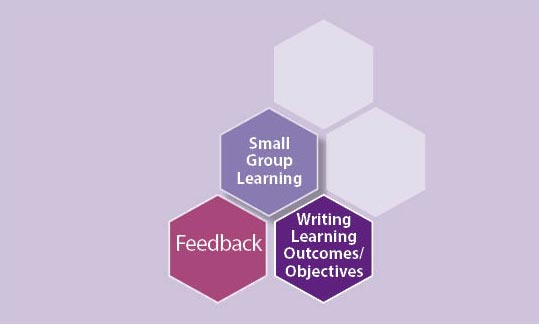
Hattie and Yates paper on "Using Feedback to Promote Learning" includes three feedback questions to help guide preparing and delivering effective feedback:

  1. What is the goal?
  2. What is the progress being made?
  3. What is the next step?

In "Feed Students through Feedback," Sandie Novak affirms that feedback is something to be planned for as part of the lesson, and that planning begins with the learning target. Once the teacher and student really know what the goal is, they can begin the process of monitoring and using feedback to adjust progress toward that goal. 

Thus, the teacher can use where students are making progress and what the next step will be to provide targeted feedback and instruction. Likewise, students can use their understanding of the goal to self-assess their progress.

How might this look in your classroom?


Friday, January 27, 2023

Take Time to Save Time: Planning to use Rubrics and Success Criteria

In a recent conversation with a team, the topic of rubrics came up. Several teachers shared that they weren't sure it was a good use of their team time and effort to put details into a rubric that students don't use well.

And this raises a good question: do we always need detailed rubrics?

Well, the short answer is, no!

But research suggests that having clear success criteria--and in cases where a skill recurs, develops, or is reviewed for a long period of time, rubrics--is powerful:
So how can we make this easier on teachers and on our time?

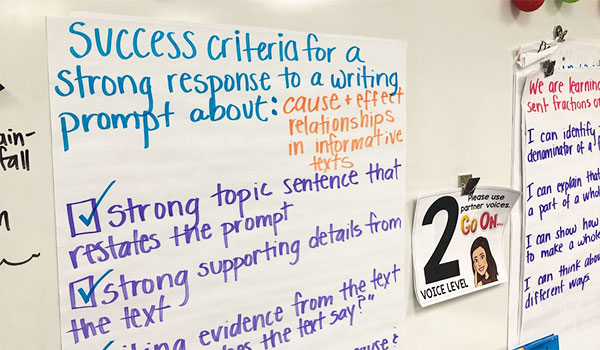
1) Have clear learning targets for the assignment, and share them in student-friendly language.

One big concern teachers share is that students can't or don't accurately monitor their progress or provide accurate feedback to each other. The more "targeted" and clear we can make expectations for students, the more likely they are to hit that target.

“When students understand exactly what they’re supposed to learn and what their work will look like when they learn it, they’re better able to monitor and adjust their work, select effective strategies, and connect current work to prior learning.” (from Brookhart and Moss “Learning Targets. On Parade” Educational Leadership, October 2014, v. 72 p. 28)

2) Use models to help build success criteria.

There is power in SHOWING, not just telling, what we are looking for. In fact, for bigger assignments, this can be done as a co-construction activity, in which the teacher shows examples of what they are looking for and asks students to identify what made the work successful. In this way, students "own" the drafting of the criteria for success

This can even develop as a checklist! This checklist can become the core of a rubric, or students can use those criteria to review their work during and after it is created.

3) Build in time for students to use them.

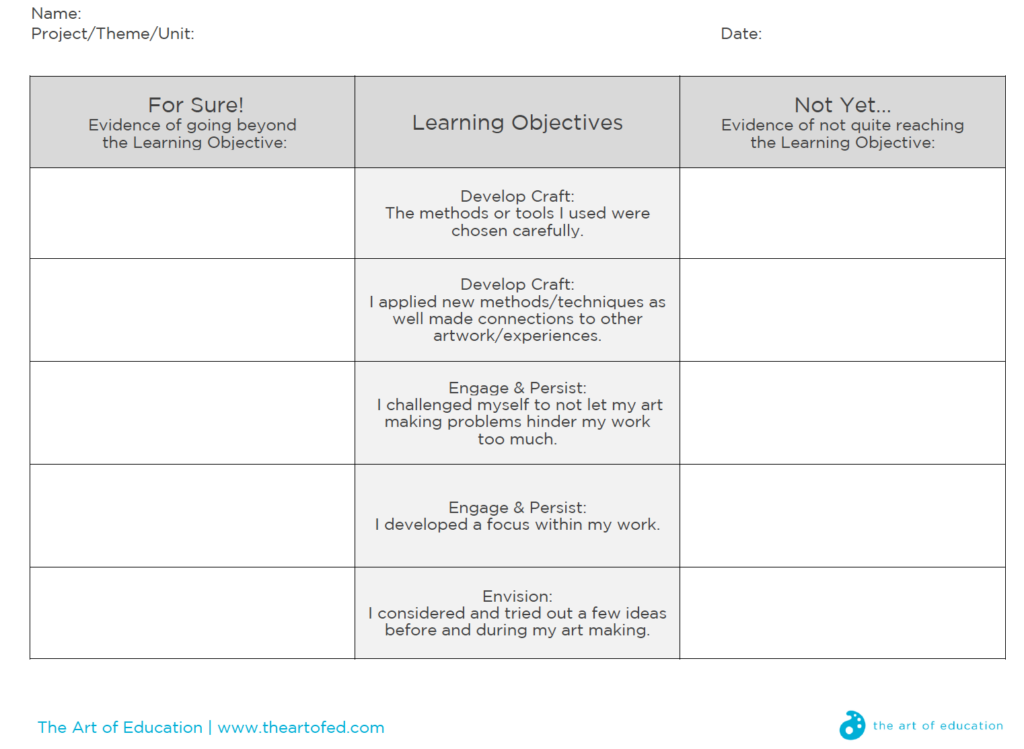
Giving class time for students to use a rubric or checklist to review and revise their work is tough--after all, there is a lot to cover in that precious time! But if we want to make sure students feel more success the first time, and to save ourselves time reteaching (and taking home assignments to write feedback on!), this is time well spent. One way to engage students is to use a single-point rubric

Not only does this save time in creating a big, detailed rubric, but it provides the student (and teacher) space to provide specific feedback on how the student work does or doesn't meet the criteria. This can be a formative assessment, as students who can't or incorrectly identify evidence that they meet the success criteria are good candidates for reteaching, while those who can identify why they aren't yet meeting success may be able to improve after self-reflection. 

Make time to save time

It seems counterintuitive to plan more class time to review learning targets, co-create success criteria, and spend time using a rubric, but that time is shown by research to be well-spent. Students show greater understanding and success, and teachers do LESS of the work in the long run. It's a win-win!

Wednesday, May 4, 2022

Fast Food Feedback: Make it Worth It!


Fast food is great because it is (usually) fast: as a consumer, you don't need to cook, wash dishes, or sometimes even get out of your car. However, if you just scarf down the food without tasting it, then you've wasted the experience.

Fast formative assessment is a little like that: if we don't take the time to "savor" that feedback, then  the effort of collecting the data was not worth it.

Most of our students are used to these faster computer-based assessments, whether in the Illustrative Math platform, on a Kahoot, or a teacher-made Google form. The benefit of having computer-based testing should be the ease of feedback: in mere moments, something that would have taken at least a half hour to mark has been scored and can be accessible to students for feedback, at least in terms of knowing what they got right and wrong.

So, how do we make students do more with that feedback than just look at the score?

Solution 1: Teacher-Made Groups
Look at the data and make some strategic decisions: are there questions that most students got wrong that warrant a whole class reteaching? Are there students in the class who got a commonly missed question right and could act as "experts" to help during a station rotation review activity? Are there groups of students who would benefit from small group re-teaching on a topic?

Solution 2: Student-Led Groups
Shift the responsibility to the students: Might you build in time for students to identify the top questions to review as a class? Might they work together to write explanations for the top (2, 3, 5?) questions they got wrong, but upon reviewing with peers, etc., they now know how to answer correctly? Might they have to share how they would do better on a similar question in the future, or write their own version of the question to show they understand?

What other solutions do you have for making students more responsible for using fast feedback?

Thursday, March 17, 2022

Start With What You're Proud Of

Who doesn't love attention for what they are doing well? When we build from our strengths, we build on a strong foundation.
This came up as teachers on the district catalyst team recently discussed student-led writing conferences. If you are a teacher who has students write (and hopefully revise), this technique is worth a look.

Some of the Benefits:

  1. Saves time
  2. More effective feedback
  3. More effective instruction

Instead of writing a bunch of comments that students may or may not read on their writing, the teacher has the STUDENTS identify what they want to focus on. This takes a few minutes of reflection for students, but saves the teacher HOURS of close reading student work. Plus, research shows that students often need support acting on written comments or they ignore them (often because they aren't timely or sufficiently helpful). 

The conferencing technique calls for teachers, instead of writing all over the student work, to devote five minutes to each student in class. During that 5 minute conference, the teacher and student review the parts of the assignment that the student identifies as wanting feedback on. Feedback works best when we also collect it from students (see Hattie, J (2009). Visible Learning: A synthesis of over 800 meta-analyses relating to achievement. New York: Routledge). The student sets the goal based on the learning target(s), making it all the more meaningful to them, and then has time to act on that feedback.

For more on how this works, you might consult Edutopia's 5 minute conferences resource and the sample comments/questions from Literacy Today.

But the addition that made this MOST effective in practice was not just asking students what they wanted to discuss for improvement, but to start by asking students to share what they were most proud of.

This had several benefits.

1. It alerted the teacher to sensitive topics. If a student was really proud about a paragraph they wrote that the teacher would have covered in real or digital red ink, then the teacher might approach feedback differently. It's hard to focus on the good when your pride and joy just got trashed.

2. It gives a snapshot of the student's level of understanding. If students are accurately identifying the good in their work, that can be valuable even for students who already don't have a lot to work on. Likewise, if a student identifies something good that isn't really great, the teacher then has a door open to addressing the misconception.

3. It gives a starting point for students who THINK they have nothing to work on. One question that was asked is what to do if students come to the conference and think everything is great. (Or they want to avoid the conference, so they claim it is great.) Asking someone what they are proud of is a non-threatening question that opens the door to adding more...rather than saying a student needs to "fix this" or throw things out. Many students will be open to feedback when the discussion starts with what is good.

And this makes sense, when we link this to what we know about behavior-specific praise being more powerful than corrective feedback in terms of changing behaviors. Who doesn't want to keep doing what earns them accolades?

If you want to know more about how student-led conferencing can work for you or for assignments other than writing, contact TLI, and we'd be happy to provide you with resources or help you co-plan this activity for your students.

Thursday, March 3, 2022

Create a Progress Report from Google Classroom

Google Classroom is amazing for so many reasons, but if you want to give parents (or SST) a progress report of Google Classroom assignments, which may include tasks that aren't reflected in the gradebook because you are looking at completion, you need a workaround.

This blog post shows you how to download a sheet from your Google Classroom gradebook.


Now, to make a simple single student progress report, you can do the following:

  1. Create a new filter view.
  2. Select only the student/data you want.
  3. Print! (Print to PDF to attach to an email)
Our video tutorial shows how, plus how you might use this to share notes about student progress.


Let TLI know if we can help, and happy conferencing!

(PS: If you are curious about other tools that work with Google Classroom, check out this demo from Schoolytics. It isn't currently an approved tool at GPS, but if you want to see more about what it can do, contact TLI.)


Friday, February 11, 2022

Finding Balance with Grading


February is always the longest short month, but this year feels harder in many ways for teachers. While there are no miracle cures, one step teachers can take to enhance teacher well-being AND student well-being is finding a balance with our assignments.
While there is plenty of research that shows the value of feedback (and tips for how to make that feedback the best possible), there is little research that supports the value of grading for student learning or well-being. Research shows that grades MIGHT impact student motivation positively if they are perceived as providing helpful feedback, but on the whole:  
"Grades did not enhance academic motivation. Instead, grades enhanced anxiety and avoidance of challenging courses. In contrast, narrative evaluations supported basic psychological needs and enhanced motivation by providing actionable feedback, promoting trust between instructors and students and cooperation amongst students." 

So, what do we as teachers do, when the reality is that grades are expected and still carry importance in the wider world?

The most recent episode of Catlin Tucker's podcast The Balance is an 11 minute gem devoted to grading. If you find yourself drowning in student work to assess, this is worth the listen. 

In her blog reflection, Catlin Tucker shares:
"A few years ago, I hit a breaking point. My grades didn’t feel like an accurate reflection of my students’ skills, and I was spending hours wading through paperwork instead of designing dynamic learning experiences for my students. Now, when I work with teachers, I encourage them to ask these questions: What is the purpose of this work? Why am I grading this?"
Catlin found that a few changes helped her spend MUCH LESS TIME grading, shift her practice to more time spent in class on feedback, reflection, and setting goals for learning, and find MORE MEANING in the time she spent giving feedback. She shares the following helpful flowchart in her blog:

If this seems interesting, take 15 minutes to check out the blog and podcast. Let TLI know if you want to chat about how you might strike this balance in your classroom!


Wednesday, January 26, 2022

I'm not that person

James Clear's book Atomic Habits has been popping up all over the place lately. (It has been the subject of a series of Teaching to the Top Podcasts, which are great if you are looking to build some new habits.) The basic thesis is that small changes or actions that we take can have a massive impact on our progress.

"Every action that you take is a vote for the type of person you wish to become." (Check out the video below for a talk from the author.)

This made us think about the power of self-talk and of habits in how we approach our classrooms. If one says I'm "not a touch-feely kind of teacher," then that person is creating a self-fulfilling prophecy. With that said, just reframing my self-talk isn't enough. If we really want to connect more with kids, then we need to think about the habits we can create to make this happen. 

The way to "become" someone is to do it. Habits change beliefs. Habits matter.

This was echoed in a recent blog post from Dave Stuart Jr, which was about creating the habit of connecting with students each day. (If you haven't read his strategy for Moments of Genuine Connection, it's worth the look.) He suggests using a roster, a clipboard, and a pen to literally "check" when connecting to students. And this connects to one of our district goals for SEL, as one of the best "habits" we can create is to give behavior-specific praise to our students.

So, if you want to become a person who praises, set a realistic goal, perhaps to praise each student in your class at least once a day or to catch a certain number of students showing a desired behavior (click for a ready-to-use tool!)

And perhaps find a teaching partner to hold you accountable, not with carrots or sticks, but with celebration and encouragement. If you miss your goal one day, your partner can encourage you to make up for it with more praise the next day, or remind you to give yourself a day of grace.

And once you meet that goal, say for a full week of school, then maybe you set your sights at two weeks, and onward and upward from there.

"Make it obvious, make it attractive, make it easy, make it satisfying." 

You can be that person.

Friday, January 21, 2022

Save Time Scoring to Spend Time on What Matters


Midterms at GHS have inspired several questions about ways to save time on scoring assessments. While there are limits to what multiple choice can assess well, questions that are carefully designed and target specific objectives can assess higher order thinking and provide teachers with the ability to provide students with fast feedback. 

Megan Faherty of Angela Watson's Truth for Teachers blog/podcast puts this well: "If you don't have time to grade it, students don't have time to learn from it."

There is so much research about the impact of feedback on student performance. But for fast feedback from these types of assessments to be meaningful, teachers need to plan for students to use it

Depending on the tools teachers use, there are many options for helping students review and use their feedback from assessments that involve limited choices.

A few ideas, such as those from "Getting Students to Engage with Feedback," 

  • "Make a connection between the expectations of an assignment and feedback. When I set an expectation, I explain how I will give feedback and the way students should apply the feedback to their work."
  • "Create opportunities for students to interact with feedback during class sessions."
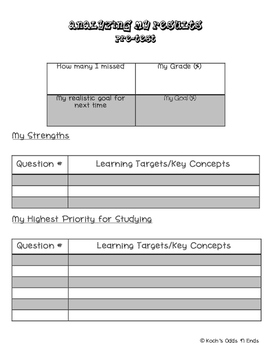
    • Students can work with peers who had similar challenges to determine what skill or concept was involved in the question troubled them, and think about what knowledge or strategies might help them in the future.
    • Teachers might also create specific plans for students to review questions or problems, recognize their strengths, and utilize resources to help address areas of struggle. Simply having students review incorrect responses and answering questions like, "Why is the correct answer better than the other options? Why did you think the answer choice selected was right? Can you find evidence for why it is wrong?" helps improve engagement with this work. 

This aligns with research that shows that "Short, low-stakes tests also help teachers gauge how well students understand the material and what they need to reteach. This is effective when tests are formative—that is, designed for immediate feedback so that students and teachers can see students’ areas of strength and weakness and address areas for growth."

Asking students to take the time to review not only saves you time, but then also leads to better results, especially if students know they can retest or they earn back credit for showing that they know the material via these test reflections.


Tools to Speed Up Grading (and Feedback)

In several posts on this blog, we talk about the value of fast feedback for student learning. So how do you do this in a way that is safe (remember CT's student data privacy rules) and speedy?

Enter tools like Google Forms and Zipgrade, which offer fast results and teacher-friendly data reporting.


Zipgrade has the advantage of working with paper. This is great if you have a longer multiple choice assessment (up to 100 questions) or secure test that wouldn't work well as a Google Form quiz OR if you don't have access to student devices. Essentially, you can print a premade scantron-style sheet to use for multiple choice, true/false, and matching questions--or create a custom one for gridded-numeric entry questions--and students will fill in their responses. The teacher then uses a smartphone or tablet with the app to scan the answer key and score the papers. A set of 20 sheets can be scored in under 2 minutes!

To see what this process looks like, watch the first few minutes of this video; this YouTuber also walks through the getting started process, which is regularly updated for iPhone and Android users on the Zipgrade website.

Zipgrade also quickly provides an overview of student scores, item analysis, and allows you to print individualized reports for students:

Class Overview Reporting
Item Analysis

Google Forms quizzes have the advantages of being completely free (Zipgrade has a limit of 100 scans/month in a free account), and offering a wider variety of question-types, embedded media, and seamless integration with Google Classroom.


The above video shows just some of the options for creating Google Forms quizzes and viewing data that will help you plan instruction and focus areas for students. 

What makes this an huge time-saver is the ability to work with Google Classroom and Infinite Campus gradebook sync to quickly pull the scores from the Form to the Classroom, and from the Classroom Gradebook to the IC Gradebook. This two minute process not only gives students quick feedback in Classroom (as you can enable them to view their quiz results), but also saves you time entering data.


Friday, December 10, 2021

Stepping on the Scale


There's an old saying along the lines of "you don't fatten up a pig by weighing it." Usually this is said in the context of standardized testing, making the point that we shouldn't sacrifice instructional time in favor of testing time, as we need to "feed" students knowledge for them to grow.

But if we extend this analogy, while we might give a pig food to eat, ultimately it has the choice whether to ingest it. Likewise, that food might not be what that pig needs to gain the weight it needs in a timely way. Just putting food in front of the pig doesn't guarantee a good outcome.

And to be clear, students are certainly NOT pigs. 

So, how do we recognize what is enticing, helpful, etc. for students? It is by continuously evaluating our actions and our students response to them, and having conversations around this evidence. This is in alignment with recent findings about the best way to boost teacher efficacy: seeing actual improvement in students’ learning as a result of specific classroom practices. In “The Past and Future of Teacher Efficacy”, Thomas Guskey describes a study showing positive results for those teachers who give frequent formative assessments and immediately follow up with students below mastery (80%). 

While assessment is not a goal unto itself and our students are certainly more than their numbers, frequent "weighing" coupled with immediate feedback is the way to help students AND teachers grow! The more frequently teachers receive targeted feedback on student performance in direct response to their lessons, and the more they provide targeted feedback to students in return, the better.

So, how can you do this easily? 

  • A favorite strategy is to use "piles" for things like entry or exit tickets. Rather than spend time grading formative assessments, teachers sort the assignments into stacks--perhaps students who fully, kind of, or don't "get it"--and then plan to follow up with small groups based on which students need what supports. Using Google forms or even Kahoots can quickly provide this data too!
  • If you feel the need to provide detailed feedback or examples, commit to a few things to share and reuse! You could use Mote to provide audio feedback--if you use Google Classroom, you can save detailed feedback in the comment bank--and quickly insert/reuse the file. Provide a few minutes in class for students to listen, reflect, and plan to implement the changes for maximum impact.

Thursday, November 18, 2021

In Praise of Praise

#CatMemes

The end of the marking period is a natural time for reflection. Teachers wonder what they and their students could have done differently to increase success. Were students working to their full potential?

 This week Edutopia posted an article on "How to Counter Students' Learned Helplessness." Often the term learned helplessness is associated with students not trying unless a teacher helps, but the article expands upon how this may show up in the classroom:

  • Refusal to accept help, even if the teacher repeatedly offers it
  • Frustration leading to easily giving up
  • Disengagement from effort
  • Lack of motivation
  • Diminished self-worth and self-efficacy (such as providing a myriad of reasons why solutions will not work)
There were several practices shared to help address learned helplessness, but one that resonated was praising and encouraging effort (as opposed to achievement). Both our recent work with Erin Dunn and another recent Edutopia post have illuminated research about how powerful praise is for both student wellness and academic engagement. The takeaway:
      While reprimands are sometimes unavoidable—and praise isn’t a panacea—working to raise the ratio of praise to reprimands is likely to improve student engagement and classroom productivity.
        The power of praise, both in and out of the classroom, is backed by research, with a general goal of 5 praise statements to every 1 correction. So aside from being mindful to increase our praise of students' specific efforts, what else can teachers do to move their praise to correction ratio in the right direction?

  • Describe the observed behaviors and make a positive remark. (Ex: “You held the door open for your classmates on your own initiative, Savannah. Major props!")
  • Place sticky notes or posters where you can see them with reminders: “Emphasize effort,” “Praise diligence,” “Fail forward!" etc.
  • Work with students to set bite-size goals, and praise in a big way when they achieve each goal.
  • Consider keeping a chart to help you make an intentional effort to connect with and praise all students.

Thursday, November 4, 2021

#NoGradeNovember

 
A student who aces the math tests earns a D in the class.

A student--a READER who always has her nose in a book--fails Language Arts for the second time.

These situations happen all over the country, but why? How does this happen, and how do we address it?

The Mindshift podcast "Grades Have Huge Impact, But Are They Effective?addresses some of these questions and the myths that surround grading. 

One of the featured teachers, English teacher Monte Syrie, shared a story about a student writer who earned a "C" because she repeatedly forgot to complete her journal entries, despite writing beautiful papers, conferencing thoughtfully with the teacher, and producing work at an advanced level. In response, he spent years thinking about how grading systems impact relationships and student motivation. 

Monte Syrie addresses how teachers can start to prioritize student learning and feedback over scores via his post "No Grade November." This gives great ideas for how people of all comfort-levels regarding changing grading can make reflection, relationships, and fairness more of a focus in the classroom.

As you close out the first marking period and think about grading as a measure of student progress, take some time to check out one of these resources and reflect: 

Are your systems working for you and your students?