Featured Post

Avoid Quarter 2 Blues: Save Time with a new Google Classroom

For those of you ending the quarter, now is the time to create a new Google Classroom for each of your classes. Organizing new classes will...

Showing posts with label Science of Reading. Show all posts

Friday, September 8, 2023

Podcast Roundup: On Reading Levels and Illustrative Mathematics


Back to school is a great time to kick off new routines or to explore new resources. Two podcasts that are of interest to us as we move Griswold Forward are "Literacy Talks" and "Making Math Moments that Matter." 

In the episodes below, researchers and experts weigh in on the instructional practices and curriculum that Griswold is moving forward with. These are worth the listen!

Literacy Talks Podcast, Episode “On Levels: A Candid Conversation with Guest Dr. Matt Burns”

The gist: A famous reading researcher shares the research on what works when working with developing and struggling readers.

Takeaways:


The gist: Illustrative Mathematics co-founder and distinguished math education professor shares the power of connecting mathematics to stories in problem-based learning. He connects to program practices and discusses the potential impact of AI and digital tools.

Takeaways:

  • To learn math, students need to do math
  • The instructional routines are key to the success of the curriculum.


Friday, February 10, 2023

Can you smell what the podcast is cooking?

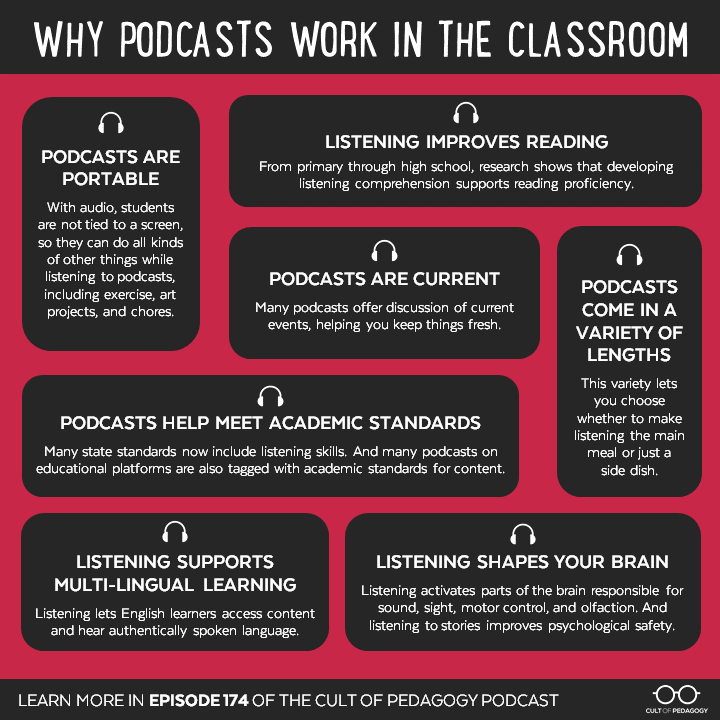
Science suggests that as you listen to a podcast or radio show about cooking and you hear the sizzle of the stove as the broadcaster describes adding garlic, the smell center of your brain will light up, activating memories and prior knowledge. You might actually SMELL the food cooking. 

https://www.cultofpedagogy.com/podcasts-in-the-classroom/


Audio, and podcasts in particular are powerful in the classroom for so many reasons:

Other benefits? You can often speed them up, slow them down, or use tools that read along with transcripts to increase accessibility. TED Talks on the TED platform include transcripts in multiple languages, which highlight as the speaker talks.

How can I use them?

  • There are many short (under 5 minute) podcasts for kids. These might be a great warm-up once a week, with the class working on retelling, identifying key information, or just brainstorming questions about a topic or current event.
  • You might use longer podcasts as part of a station rotation to build prior knowledge or provide more first person, non-fiction accounts of events.
  • You might use podcasts to appeal to different learning modalities, giving kids the option to listen to sources rather than simply reading all of them.
  • You can create IAB-style comprehension questions to help students practice for the listening part of the SBAC test, and discuss the techniques students used during listening. Kids can listen and discuss  individually, in small groups, or as a whole class.
  • You can use them to model, guide, and have students practice the note-taking skills you teach.
  • Have students write (or use flip to record) the connections they make between the current events from the audio to the historical events, general science topic, or other concepts they are learning about.

For links to elementary-age podcasts, check out this resource.

For more research, check out the Cult of Pedagogy blog/podcast about using podcasts.

For more ideas, listen to or view the video podcast from Truth for Teachers.


Friday, December 9, 2022

Pass the Vocabulary

This week, in speaking about the importance of building knowledge and teaching vocabulary as part of the science of reading, we were reminded of a favorite activity of students and several GHS English teachers: the "pass the vocabulary" story. Here's how it works: 

  1. Using a given word list, each student would take a blank piece of paper and write the first sentence(s) or a story using one of the words correctly. (TIP: Have students highlight or circle the word, to make it easy to know what was used!!)
  2. After the given time (1 minute), they passed the paper to the next person.
  3. The next person would write the next sentence(s) of the story, using a different vocabulary word.
  4. The process of writing and passing would continue until time came for all the words to be used.
  5. At the end, students would take their stories and join a small group, which would share the stories for peer review for meaning, revise, and then share out the "best" story from the group.
Students LOVED this activity, as the stories often got very silly by the end, and it was a great challenge. They also loved that they had a chance to discuss and revise the stories, as it rewarded their growth. And teachers, well they loved that students had to discuss, correct themselves, and collaborate in a low-prep activity that the students themselves helped evaluate. 

So, aside from being fun and easy, why is this valuable?

The science of reading makes it clear that pre-teaching vocabulary is important; students need to build knowledge, especially knowledge of words, to be more proficient readers. But this applies beyond students learning to read, and continues as students read to learn across the content areas.

Learning science also shows that memorizing a list of vocabulary words and their definitions for a quiz--especially a matching or multiple choice quiz--isn't a great indicator of how well students have learned words. Most often, students cram, storing these words in their short term memory, but not making the connections that encode them into their long term memories in ways that make the learning stick. Students, especially struggling students, need a dozen or more exposures to words and their meanings to fully learn them.

Research suggests that these things help students with vocabulary building:

  • Explicit instruction of words and their meanings increases the likelihood that young children will understand and remember the meanings of new words.
  • Higher frequency of exposure to targeted vocabulary words will increase the likelihood that young children will understand and remember the meanings of new words and use them more frequently.
  • Questioning and language engagement enhance students’ word knowledge. This can include retrieval practice, scaffolding from low-demand questions (i.e. meaning) to high-demand questions (i.e. how would you use...?)
Now, this means that students can't just start by writing stories. Teachers need to make time for explicit instruction, be it reviewing the words with students in context, or reviewing the roots or related words, or to support students in making Freyer Models or semantic maps/word webs. But beyond that, students need time to work with the words.

But what if I don't want my students writing stories.

Another group activity that was relatively low prep was a card sort. Have student groups make index cards (or cut out card sets) of the vocabulary words. Then, have students organize them into 3-4 categories. This could be categories you provide, or categories the students create. They then have to explain why the words belong together, and how they relate.

Here are some other ideas:

  1. Pass the Parcel: Review vocabulary in whole group or small group with a game-like atmosphere with some bags full of vocabulary.
  2. Paper Plate Match Game: Have small groups cut paper plates in half, and write the word on one half and on the other, write a definition, synonym, antonym, example, etc. (whatever serves your purpose). Then have them shuffle them up and find a match.

Want more? Check out these ideas from We are Teachers and Gifted Guru.

Saturday, April 9, 2022

Review at the Loo


In the past few years, many people have been promoting "Potty PD," or quick items for professional learning that can be shared in places where teachers have to wait (i.e. outside the bathroom or next to the copy machine). 

A teacher at Thursday's LEARN book club for The Six Shifts (about the practicalities of implementing instruction based in the science of reading) shared a similar idea, but for students.

Essentially, she shared that teachers use the time waiting outside the bathroom for classmates to have their turn as a time to play review games for phonics, math facts, etc. She shared that this improved student behavior and made this time academically enriching.

For more about resources from The Six Shifts and related to the Science of Reading, check out TLI's Curriculum Development Website.

To join the LEARN book club (reading the book is not required!), contact TLI.

Thursday, October 14, 2021

Fun with Phonics

For folks interested in the science of reading and who are working with students using Fundations, a resource of interest might be a recent webinar from Edweb.net

Expert Wiley Blevins shares his thoughts on "Making Phonics Instruction More Meaningful and Effective," and what is great about this is that he isn't fighting the program--rather, he has ideas for how to plan with the programs to make this instruction more powerful for all of our learners. 

While the first 10-15 minutes are a bit dry, once you get to the slide above, the content becomes very useful and applicable. He gives great and EASY ideas for how to add opportunities for differentiation that take 5-10 minutes to implement. 


Click here to View the edWebinar Recording, and let the TLI department know if you want to talk more about ideas for phonics instruction!